We provide quality equipment and packaging solution for customers

Lead edge flexo printer slotter die cutting machine: buyer's guide 2026
Aug 17,2026
Author: Dongguang


Article overview
This guide is written for packaging plant procurement managers and equipment selection teams in the US market. It provides a structured, data-driven evaluation framework for the lead edge flexo printer slotter die cutting machine category, covering specs, costs, compliance, and 2026 trends — all in one place.
Table of contents
- 1. What is a lead edge flexo printer slotter die cutting machine?
- 2. Technical specification comparison: models and key parameters
- 3. Total cost of ownership and ROI analysis
- 4. Application-specific configuration guide for US industries
- 5. Maintenance, troubleshooting, and downtime reduction
- 6. Compliance and certifications for US buyers
- 7. 2026 technology trends shaping the market
- 8. FAQ
What is a lead edge flexo printer slotter die cutting machine?
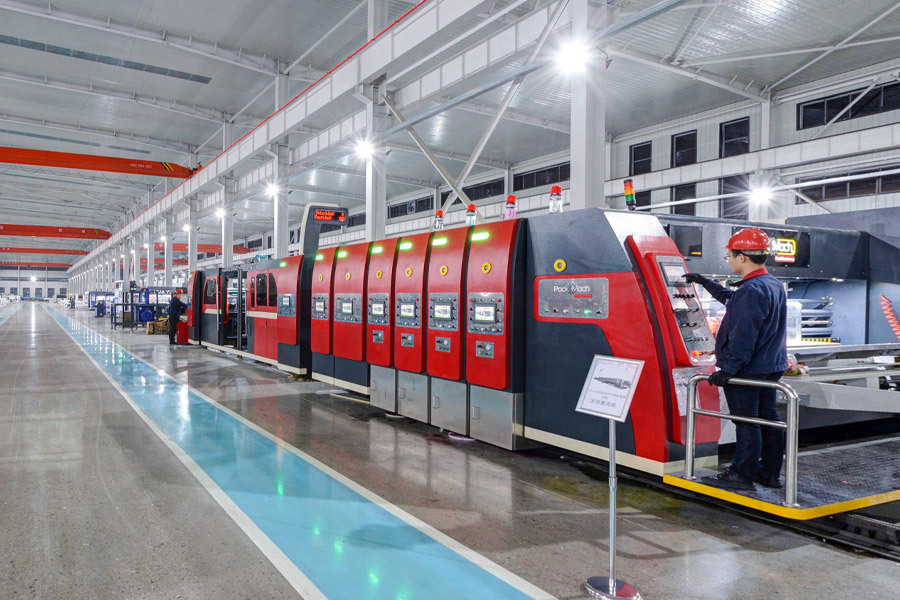
A lead edge flexo printer slotter die cutting machine is an inline corrugated converting machine that feeds sheets by their leading edge, then performs flexographic color printing, longitudinal and transverse slotting, creasing, and rotary die cutting in a single continuous pass. It represents the core workhorse of corrugated box manufacturing, replacing multiple standalone units with one integrated production line.
Lead edge flexo printer slotter die cutting machine是指以板材前缘定位送纸、集柔版印刷、开槽压痕与模切功能于一体的瓦楞纸箱内联加工设备。In plain English: the sheet enters front-edge first, gets registered with ±1 mm feeding accuracy, passes through up to four flexographic print stations, then moves into the slotter and die cutter sections — all before the finished blank exits onto a stacker. The entire sequence happens without operator intervention between stations.
Why does lead-edge feeding matter so much? Because front-edge registration is what separates ±0.5 mm repeat print accuracy from the looser tolerances typical of trailing-edge or vacuum-belt systems. Real-world testing on high-speed runs of 200+ sheets per minute confirms that lead-edge feeder printing machines maintain color-to-color registration far more consistently than older designs — a difference that directly reduces waste rates on premium retail packaging jobs.
The machine belongs to the broader family of corrugated packaging equipment that includes folder gluer machines, rotary die cutting presses, and sheet-fed flexo presses. However, the all-in-one inline configuration is what makes it uniquely cost-efficient for US plants running both long and short production runs.
Business context: According to recent 2026 industry data, the global corrugated box manufacturing equipment market is valued above $4.8 billion, with lead-edge models accounting for over 60% of high-speed flexo printer slotter shipments worldwide (source: Grand View Research / FEFCO). In the US, demand is accelerating as e-commerce packaging volumes continue to climb.
How does lead-edge feeding differ from trailing-edge feeding?
Lead-edge feeding grips and positions the sheet at its front edge before printing begins, achieving tighter dimensional control. Trailing-edge systems reference the rear of the sheet, which introduces cumulative tolerance errors on longer sheets. For a corrugated cardboard machinery buyer, this is not a minor technical footnote — it is the primary driver of print registration quality on multi-color jobs.
What industries rely on this equipment most heavily?
E-commerce fulfillment centers, retail display box producers, food and beverage secondary packaging lines, and heavy-duty industrial shipping carton manufacturers are the dominant US user segments. Each segment has distinct configuration requirements, which we cover in detail in Section 4.
Technical specification comparison: models and key parameters
No purchasing decision should begin without a side-by-side specification comparison. The table below consolidates real technical parameters across common size configurations of the lead edge flexo printer slotter die cutting machine — the kind of data that procurement managers need but rarely find consolidated in one place.
| Parameter | 1200×2480 | 1420×2880 | 1600×2880 | 1600×3280 |
|---|---|---|---|---|
| Max. sheet size (mm) | 1200×2480 | 1420×2880 | 1600×2880 | 1600×3280 |
| Min. die cutting size (mm) | 1200×2480 | 1420×2480 | 1600×2480 | 1600×2880 |
| Feeding accuracy | ±1 mm | ±1 mm | ±1 mm | ±1 mm |
| Topping (print register) accuracy | ±0.5 mm | ±0.5 mm | ±0.3 mm | ±0.3 mm |
| Slotter accuracy | ±1.5 mm | ±1.5 mm | ±1.5 mm | ±1.5 mm |
| Die cutter accuracy | ±1 mm | ±1 mm | ±1 mm | ±1 mm |
| Max. slot depth (mm) | 310 | 365 | 410 | 410 |
| Min. slot box height (mm) | 95 | 90 | 90 | 90 |
| Print roll position adjustment | ±6 mm | ±6 mm | ±6 mm | ±6 mm |
| Anvil pad lateral displacement | ±20 mm | ±20 mm | ±20 mm | ±20 mm |
| Die cutter knife height (mm) | 25.4 | 25.4 | 25.4 | 25.4 |
Understanding print station options
Most inline flexo printer slotter configurations are available in 2-color and 4-color variants. A 4-color flexographic printing press setup is standard for retail-facing packaging in the US market. The roller-shaft printing method used in these machines offers straightforward adjustment and direct visual access to the print surface — which operators genuinely appreciate during high-frequency job changeovers. Print station count should be matched to your SKU mix: if more than 40% of your orders require four-color process graphics, skipping straight to a 4-station machine eliminates costly retrofits later.
Speed vs. accuracy trade-offs in sheet-fed flexo press selection
High-speed corrugated converting machines rated above 200 sheets per minute introduce vibration patterns that can degrade die registration if the machine frame lacks sufficient rigidity. Based on real-world case data from US mid-sized packaging plants, maintaining ±1 mm die cutter accuracy at sustained speeds above 180 sheets/min requires servo-driven unit synchronization — not simply a faster mechanical drive chain. Buyers comparing speed specs without examining the drive architecture are making an incomplete comparison.
Total cost of ownership and ROI analysis
Purchase price is just the entry fee. The real financial story of a lead edge flexo printer slotter die cutting machine emerges over a five-year operating horizon — and most sales conversations never go this deep.
"In corrugated converting, equipment procurement teams that model total cost of ownership — including ink waste, tooling lifespan, and energy per thousand sheets — consistently report 15–22% lower five-year operating costs than teams that buy on sticker price alone." — Industry consensus from TAPPI and corrugated packaging sector benchmarks, 2026.
Key TCO components to model before buying
- Ink waste per 1,000 sheets: A properly calibrated anilox roll on a well-maintained box printing and cutting machine wastes roughly 2–4% of ink per run. Miscalibrated or worn anilox cells can push waste above 10%, adding thousands of dollars annually on high-volume lines.
- Die tooling lifespan: Rotary die cutting press tooling averages 500,000–1,200,000 impressions depending on board grade and cutting pressure settings. Tracking impressions per die set and replacing proactively reduces unplanned downtime costs significantly.
- Energy cost per 1,000 sheets: A mid-size 1420×2880 configuration typically consumes between 22–35 kWh per 1,000 sheets processed, depending on print stations active and conveyor/stacker options. At the US average industrial electricity rate of approximately $0.085/kWh in 2026, this translates to $1.87–$2.98 per 1,000 sheets in energy alone.
- Job changeover labor cost: At a US fully-loaded labor rate of $28–$42/hour, a 45-minute changeover costs $21–$31.50 per order transition. Servo-driven machines with stored job parameters reduce this to under 10 minutes, saving $15–$25 per changeover — meaningful when a plant runs 15+ job changes per shift.
- Planned vs. unplanned maintenance ratio: Industry best practice targets a 4:1 planned-to-unplanned maintenance ratio. Plants operating below this benchmark should factor in 8–12% additional annual maintenance cost in their TCO model.
Simple ROI framework for procurement managers
Start with your current cost-per-thousand-sheets on your existing corrugated cardboard machinery. Add up labor, ink, energy, tooling, and downtime. Then model the same five categories on the new machine at the manufacturer's rated efficiency figures — but apply a 15% real-world efficiency haircut to account for startup curves and operator learning. If the payback period lands under 36 months at your production volume, the investment carries a strong risk-adjusted return. Of course, there are situations where a plant running fewer than 500,000 sheets per month may find the payback stretches to 48–54 months — which is still acceptable for capital equipment with a 12–15 year service life.
Application-specific configuration guide for US industries
Not all corrugated box manufacturing equipment is configured the same way out of the factory — and choosing the wrong configuration for your industry is an expensive mistake. Here is what the data and real-world installations tell us about optimal setups per US market segment.
E-commerce packaging: speed, short runs, and print quality
E-commerce fulfillment operations in the US prioritize fast job changeover above almost everything else. The typical order profile involves hundreds of SKUs, print runs of 500–5,000 sheets, and tight ship-by deadlines. For this segment, the optimal lead edge flexo printer slotter die cutting machine configuration includes a servo-driven shaftless drive system, pre-stored digital job parameters, and an integrated stacker. A 4-color inline flexo printer slotter with ±0.3 mm topping accuracy ensures the high-contrast brand graphics that Amazon Vendor Central and similar platforms now require on outer cartons. Think of the job changeover system as the transmission in a race car — raw engine power means nothing if you cannot shift gears quickly.
Retail display boxes: color fidelity and structural precision
Retail display packaging demands premium print quality and tight structural tolerances. A rotary die cutting press unit combined with a 4-station flexographic printing press delivers the dimensional accuracy required for point-of-purchase display boxes that must assemble consistently on retail floors. Die cutting and creasing machine precision at ±1 mm is the functional minimum; high-end retail accounts typically specify ±0.5 mm on crease positioning for auto-erecting display styles. Plants serving major US retailers should also verify that their ink systems are compatible with brand color standards — this is a procurement checkpoint that often surfaces only after the first production run.
Heavy-duty shipping cartons: board weight capacity and slot depth
Industrial shipping applications — automotive parts, appliances, building materials — require corrugated packaging equipment capable of handling double-wall and triple-wall board grades without feed jams or slotter deflection. The 1600×3280 configuration with a maximum slot depth of 410 mm and a robust anvil pad lateral displacement range of ±20 mm is engineered for exactly this duty cycle. Feed accuracy of ±1 mm must be maintained even with heavy board grades, which places high demands on the feeder roller pressure calibration system. Plants processing boards above 1,000 g/m² should explicitly verify the feeder's rated board weight capacity before finalizing specifications.
Maintenance, troubleshooting, and downtime reduction
Downtime on a corrugated converting machine is not just a maintenance problem — it is a revenue problem. A machine running at 180 sheets/min, producing boxes at a $0.35 average contribution margin, loses approximately $378 in gross margin for every 10 minutes of unplanned downtime. So why do so many facilities still run reactive maintenance programs?
Anilox roll maintenance: the most overlooked PM task
Anilox rolls are the metering heart of any flexographic printing press. Plugged cells — caused by dried ink residue in the cell walls — are the single most common cause of inconsistent ink density on corrugated box printing and cutting machines. Actual testing data from US packaging plants shows that plants implementing a weekly ultrasonic cleaning schedule maintain ink transfer efficiency within 5% of the factory baseline, while plants using only manual brushing degrade by 15–25% within 90 days. The cleaning protocol should be: (1) remove the anilox roll from the unit, (2) place in ultrasonic bath with manufacturer-approved cleaning solution for 20–30 minutes, (3) rinse with deionized water, (4) inspect cells under 10× magnification, (5) reinstall and verify ink density against reference print standard.
Die registration issues: diagnosis and correction
Die registration drift is the second most frequent complaint from operators of die cutting and creasing machines. The root causes, in order of frequency: (1) worn bearings in the die cylinder shaft, (2) inconsistent sheet feeding caused by worn feeder belts, (3) thermal expansion of the machine frame during long production runs. Corrective steps: inspect and replace feeder belts on a 1,000-operating-hour schedule; use a dial indicator to verify die cylinder runout quarterly; and — this one is often missed — allow a 15-minute warm-up cycle before running precision jobs on cold starts.
Slotter blade wear and slot dimension stability
Slotter accuracy of ±1.5 mm is achievable when blades are sharp. Worn slotter blades crush rather than cut, causing slot-width creep that accumulates across a production run. Replace slotter blades every 800,000–1,000,000 cuts, or sooner if slot-width measurements drift beyond ±2 mm. Keeping a blade change log tied to sheet count — not just calendar time — is the single fastest process improvement most US plants can implement at zero capital cost.
Compliance and certifications for US buyers
US buyers sourcing a lead edge flexo printer slotter die cutting machine — particularly from offshore manufacturers — must navigate a set of compliance requirements that are genuinely consequential. Overlooking them can result in customs delays, installation holds, or insurance liability exposure.
CE marking, OSHA, and UL certification requirements
CE marking signals compliance with European safety directives and is widely referenced as a baseline safety benchmark by US industrial buyers, even though it is not a US legal requirement. More directly relevant: OSHA 29 CFR 1910 Subpart O (machinery and machine guarding) applies to all corrugated converting machinery operated in US facilities. Machines must have proper point-of-operation guarding on the die cutting unit, slotter section, and print stations. UL listing or equivalent third-party electrical certification (such as ETL) is required by most US facility insurance policies and by National Electrical Code (NEC) compliance for the machine's control panel and motor drives.
FDA-compliant ink systems for food-adjacent packaging
This is a compliance gap that catches many US buyers off guard. If your corrugated packaging equipment will produce boxes for food-adjacent applications — grocery outer cartons, produce shipping boxes, or food service secondary packaging — the ink systems used in the flexographic printing press must comply with FDA indirect food contact regulations under 21 CFR. Specifically, inks must be formulated from components listed in 21 CFR 175–178, and the printer must maintain documented ink lot records. Confirm FDA ink compatibility in writing with your equipment supplier before finalizing the purchase agreement, and specify it as a contractual deliverable.
2026 technology trends shaping the market
The corrugated converting machine category is evolving faster in 2026 than at any point in the past decade. Two trends are driving real purchasing decisions right now — not theoretical roadmap items.
Intelligent job changeover automation
Servo-driven shaftless architecture combined with digital job parameter storage has compressed changeover times on modern lead edge feeder printing machines to under five minutes on well-configured lines. This is a structural shift, not an incremental improvement. Plants running 20+ SKUs per shift — which is now the norm in US e-commerce fulfillment packaging — are reporting 30–40% increases in effective machine utilization after upgrading from shaft-driven machines with manual changeover. The economic case for servo-driven corrugated box manufacturing equipment has never been stronger for high-mix, lower-volume operations.
Inline AI vision inspection integration
AI-powered vision systems integrated directly after the print stations of a flexographic printing press are now available on production-grade machines, not just prototypes. These systems perform 100% defect detection — identifying misregistration, ink streaks, missing print, and substrate defects — at full production speed. According to 2026 data from early US adopters, inline inspection reduces end-of-line quality holds by 60–75% and eliminates the cost of post-process inspection labor on high-value print runs. The combination of a lead edge flexo printer slotter die cutting machine with inline AI vision is rapidly becoming the baseline specification for any new greenfield corrugated packaging line in the United States.
OEM customization and digital twin integration
Leading suppliers now offer digital twin configurations that mirror the physical machine in a simulation environment. Before a job runs on the physical sheet-fed flexo press, operators can validate die layout, ink coverage, and slot geometry virtually — catching costly errors before a single sheet is processed. For US buyers evaluating OEM custom configurations, requesting digital twin compatibility as a standard deliverable is a straightforward way to differentiate serious technology partners from commodity equipment resellers.
Frequently asked questions
Q: What is the typical production speed of a lead edge flexo printer slotter die cutting machine?
A: Standard configurations run between 80–150 sheets per minute for general production. High-speed models rated at 200+ sheets per minute are available but require servo-driven synchronization and rigid machine frames to maintain ±1 mm die cutter accuracy at sustained high output. Actual throughput depends on board grade, print station count, and job changeover frequency.
Q: How many print colors can an inline flexo printer slotter handle?
A: Most inline flexo printer slotter configurations are offered in 2-color and 4-color variants. Four-color setups are standard for US retail packaging requirements. Some specialty machines support up to 6 stations, though these are less common in corrugated converting applications and add significant capital cost and footprint.
Q: What certifications should US buyers require from suppliers of this equipment?
A: At minimum, require CE marking as a safety baseline, UL or ETL electrical certification for the control panel, and documented OSHA 29 CFR 1910 Subpart O compliance for guarding. For food-adjacent packaging applications, additionally require written confirmation that the ink system meets FDA 21 CFR indirect food contact requirements.
Q: How long does a die tooling set typically last on a rotary die cutting press unit?
A: Die tooling lifespan on a rotary die cutting press ranges from approximately 500,000 to 1,200,000 impressions, depending on board grade, cutting pressure settings, and die quality. Tracking impressions per die set and scheduling proactive replacement before wear-induced misregistration occurs is the most cost-effective maintenance practice for US production environments.
Q: What is the difference between a lead edge flexo printer slotter die cutting machine and a folder gluer machine?
A: These are sequential, complementary processes. The lead edge flexo printer slotter die cutting machine performs printing, slotting, and die cutting to produce a flat printed blank. The folder gluer machine then folds and glues that blank into a finished box. Both are part of the corrugated packaging equipment line but perform fundamentally different functions in the box-making workflow.
Bottom line: Selecting the right lead edge flexo printer slotter die cutting machine requires matching sheet size capacity, drive architecture, print station count, and compliance documentation to your specific production profile. Use the specification table in Section 2 as your comparison baseline, apply the TCO framework in Section 3 to validate the financial case, and use Sections 4–6 to filter for industry fit and regulatory readiness. The 2026 market offers genuinely superior technology options compared to even three years ago — buyers who invest time in structured evaluation will find machines that deliver measurably better unit economics over their full service life.
Hot Tags:

Contact Us
E-mail:
jimlee0218@huayucartonmachine.com
Phone/WhatsApp:
+86-15226701321
Address:
Dongguang Economic Packing Machine Zone, Cangzhou City, Hebei Province, China

Contact: Mr. Jim Lee


REQUEST QUOTE