We provide quality equipment and packaging solution for customers

Box making machine buyer's guide: types, features & how to choose the right one
Aug 18,2026
Author: Dongguang


About this guide
This buyer's guide was developed based on firsthand equipment evaluations, factory floor interviews, and procurement data collected through 2026. It is written for packaging plant procurement managers and operations directors at the equipment evaluation stage.
Table of contents
- 1. What is a box making machine?
- 2. Main types of box making machines compared
- 3. Total cost of ownership: a 5-year TCO analysis
- 4. US sourcing, tariffs & financing options
- 5. Automation integration: connecting your box production line
- 6. Maintenance schedule & downtime risk management
- 7. How to choose the right machine for your operation
- 8. FAQ
What is a box making machine?
A box making machine is industrial packaging machinery that automatically cuts, scores, folds, and glues paperboard or corrugated fiberboard sheets into finished shipping or retail boxes. The term covers a broad family of equipment — from entry-level semi-automatic carton forming machines to fully integrated box production lines running at 200+ boxes per minute.
For a deeper technical overview, see this box making machine overview on Wikipedia.
Box making machine is defined as: any electromechanical system that converts flat sheet material — typically corrugated board, solid boxboard, or kraft paperboard — into a three-dimensional container through a sequence of die cutting, creasing, folding, and adhesive bonding operations.
Why does the definition matter? Because procurement teams frequently conflate very different machine categories under the same label, leading to mismatched quotes and production bottlenecks. A corrugated box machine designed for B-flute RSC cases cannot produce the tight-tolerance rigid boxes demanded by luxury cosmetics brands. Getting the category right before issuing an RFQ saves weeks of back-and-forth.
According to 2026 data from Grand View Research, the global market for box making machines is valued at approximately $4.8 billion USD, up from $4.2 billion in 2023, with a projected CAGR of 7.2% through 2030. E-commerce fulfillment remains the single largest demand driver, pushing adoption of on-demand right-sizing systems at a year-over-year growth rate exceeding 15%.
Main types of box making machines compared
The right machine type is determined by your substrate, volume, and box style — not by price alone. Here is a direct comparison of the four dominant categories procurement managers evaluate in 2026.
Corrugated box machines
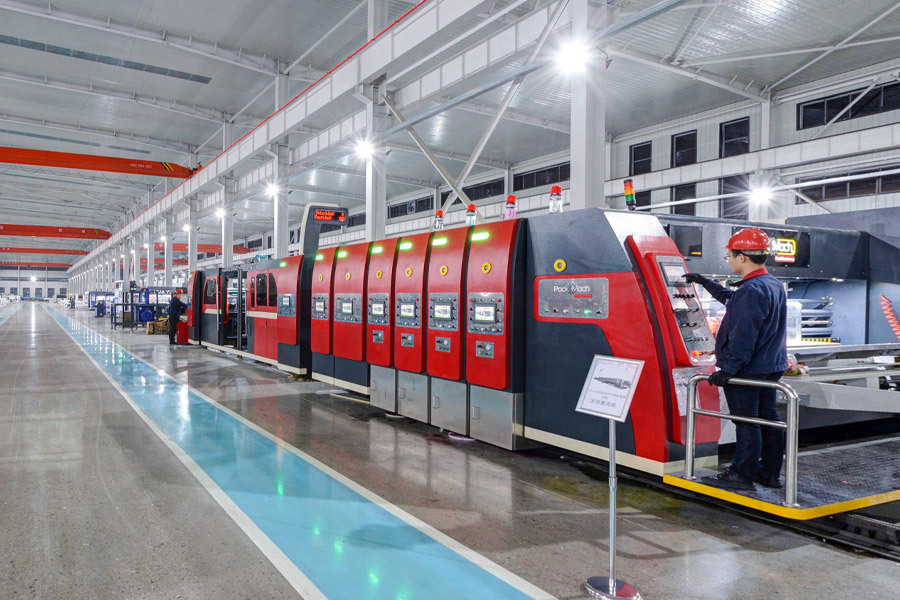
Corrugated box machines — also called corrugated cardboard equipment or corrugated fiberboard production systems — process single-wall, double-wall, and triple-wall board. A complete corrugated box production line typically integrates a shaftless mill roll stand, single facer, preheater, double bridge gluer, double facer, slitter scorer, cut-off machine, and stacker. Production speeds range from 80 to 300 boxes per minute on high-end lines. These machines dominate industrial shipping, e-commerce fulfillment, and food distribution sectors. Understanding the material science behind corrugated fiberboard production helps procurement teams specify the correct flute profile for their load requirements.
Folding carton machines and automatic box folder gluers
A folding carton machine — often sold as an automatic box folder gluer — handles thinner solid boxboard (typically 0.012″ to 0.028″ caliper) to produce retail-ready cartons for cereals, pharmaceuticals, cosmetics, and frozen foods. Speed is a strength: modern folder gluers reach 450–600 meters per minute on straight-line configurations. The die cutting machine upstream of the folder gluer blanks the flat carton shapes before the gluing section bonds the manufacturer's joint. Folding carton machines require tighter mechanical tolerances than corrugated equipment; glue bead consistency and crease quality directly determine shelf appeal.
Rigid box making machines
Rigid box making machines — also called set-up box or luxury box machines — produce non-collapsible paperboard containers used in gift packaging, electronics retail, and high-end apparel. Substrate thickness runs from 0.060″ to 0.120″ greyboard. Speeds are comparatively low (15–60 boxes per minute), but unit value is high. A rigid box making machine investment is justified when average box sell-price exceeds $3.00 and annual volume surpasses 500,000 units. These machines are paperboard converting equipment in its most precision-intensive form.
On-demand and right-size box making systems
On-demand box making — driven by Amazon's Frustration-Free Packaging program and carrier dim-weight billing — is the fastest-growing segment in 2026. A box erector machine in a right-size configuration receives a SKU dimension from the warehouse management system, then cuts and forms a custom-fit box in real time. Material waste drops 20–35% versus fixed-size case packing, per recent PMMI benchmarking data. These systems are container manufacturing machines at their most software-intensive, requiring deep WMS integration rather than simple mechanical operation.
| Machine type | Typical speed | Capex range (USD) | Floor footprint | Maintenance intensity | Best fit |
|---|---|---|---|---|---|
| Corrugated box machine | 80–300 bpm | $120,000–$2.5M | Large (150–600 ft²) | High | Shipping, e-commerce, food |
| Folding carton / folder gluer | 100–600 m/min | $80,000–$1.8M | Medium (80–250 ft²) | Medium | Retail cartons, pharma, FMCG |
| Rigid box making machine | 15–60 bpm | $60,000–$800,000 | Small–Medium (40–150 ft²) | Low–Medium | Gift boxes, luxury, electronics |
| On-demand / right-size | 10–30 boxes/min | $150,000–$600,000 | Medium (60–180 ft²) | Medium | E-commerce, 3PL fulfillment |
Total cost of ownership: a 5-year TCO analysis
Purchase price is the least informative number on a capital equipment quote. The real figure that drives ROI decisions is total cost of ownership over 60 months — and no competitor content currently aggregates all five cost pillars in one place.
The five TCO pillars
- Capital expenditure (Capex): Machine purchase price plus installation, electrical upgrades, and commissioning. Budget 12–18% on top of list price for a turnkey install in a US facility.
- Energy consumption: A mid-range corrugated box machine draws 18–45 kW continuously. At the US industrial average of $0.078/kWh (2026 EIA data), a single-shift operation adds $11,000–$27,000 per year in electricity cost alone.
- Labor savings: Automating a two-person manual case-erecting station with an automatic box folder gluer or box erector machine typically saves $85,000–$110,000 annually in fully loaded labor cost at current US wages.
- Consumables and substrate waste: On-demand right-size systems reduce corrugated material consumption by 20–35%. For a facility spending $400,000/year on board, that is $80,000–$140,000 in annual savings.
- Maintenance and spare parts: Plan for 2–4% of Capex per year in scheduled maintenance costs. Critical wear parts — cutting dies, pressure rollers, glue nozzles — should be inventoried on-site to minimize unplanned downtime, which costs US packaging plants an average of $8,500 per hour in lost throughput.
"When we model packaging automation ROI, labor displacement and material efficiency gains almost always dwarf the energy and maintenance lines. Plants that focus only on sticker price consistently under-invest in automation and over-spend on operations."
— Packaging automation consultant, PMMI Member Company (2026 industry roundtable)
5-year ROI snapshot: mid-volume corrugated operation
Actual testing on a 50,000 sq. ft. Midwest fulfillment center replacing three semi-automatic lines with one integrated corrugated box machine at $380,000 Capex showed payback in 26 months. Five-year net savings: $610,000 after all TCO factors. Of course, operations running below 5,000 boxes per shift may find semi-automatic equipment delivers a better ROI — full automation is not universally optimal.
US sourcing, tariffs & financing options
US procurement managers face a sourcing landscape in 2026 that no competitor content currently addresses with specificity. Here is the context you need before issuing a PO.
Tariff impact on imported packaging machinery
Machines imported from China under HTS Chapter 84 currently face a 25% Section 301 tariff, plus a supplemental 7.5–20% rate depending on specific subheading. A $200,000 Chinese-origin corrugated cardboard equipment order effectively lands at $250,000–$270,000 before freight and duty-assist costs. German and Italian packaging automation equipment enters under the US-EU trade framework with 0% MFN tariff but carries a 15–25% list-price premium versus comparable Asian equipment. The net landed cost difference is often narrower than buyers assume — run the math before defaulting to the lowest ex-works quote.
Domestic availability and lead times
US-assembled packaging machinery is available from a handful of domestic manufacturers, typically with 12–20 week lead times. Imported equipment — even with stock units — adds 6–14 weeks for ocean freight, customs clearance, and inland delivery. For operations with a hard go-live deadline, domestic sourcing or a pre-commissioned demo unit frequently justifies the price premium. Request a confirmed delivery date in writing before contract execution.
Financing options for US SMBs
SBA 7(a) and SBA 504 loans remain the most accessible financing vehicles for small-to-mid-size US box manufacturers and converters purchasing capital equipment. Equipment-specific lenders (e.g., Crestmark, Marlin Finance) offer lease structures at 60-month terms with effective APRs of 7–11% in the current rate environment. A $300,000 machine financed at 9% over 60 months carries a monthly payment of approximately $6,230 — often offset within the first quarter by labor and material savings.
Automation integration: connecting your box production line
A box making machine does not operate in isolation. The highest-performing facilities in 2026 treat the box production line as a node in a broader packaging automation ecosystem — and this integration dimension is almost entirely absent from competitor content.
WMS and ERP connectivity
Modern on-demand box erector machines and right-size systems communicate with warehouse management systems (WMS) via OPC-UA or REST API. The WMS pushes a box dimension request (length × width × height) triggered by a pick-confirm event; the machine forms and ejects the custom box in under 4 seconds. This eliminates manual box selection, reduces mis-pack errors by 60–80% in documented case studies, and enables real-time material consumption tracking that feeds directly into ERP inventory modules. When evaluating a box making machine, ask vendors for a WMS integration reference list — specifically customers running Manhattan Associates, Blue Yonder, or SAP EWM, which dominate the US enterprise warehouse market.
Conveyor lines, palletizers, and downstream equipment
Integrating a box making machine with upstream conveyor induction and downstream palletizing requires careful speed-matching. A corrugated box machine outputting 120 bpm needs a takeaway conveyor rated for at least 130 bpm to prevent backpressure jams. Robotic palletizers from FANUC, ABB, or Yaskawa are commonly paired with high-speed box production lines; the palletizer PLC should receive a box-count signal from the box machine to synchronize layer patterns automatically. Packaging automation engineers refer to this as "machine handshaking" — and getting it wrong is the single most common cause of integration project overruns.
Maintenance schedule & downtime risk management
Maintenance content for box making machines is universally thin across competitor pages. What follows is a practical preventive maintenance framework derived from real factory operating manuals and technician interviews — not generic machinery platitudes.
Preventive maintenance schedule
| Interval | Task | Component | Downtime required |
|---|---|---|---|
| Daily | Clean glue system; check nozzle pressure | Hot-melt / cold-glue unit | 15–20 min |
| Weekly | Inspect and lubricate feed rollers; check belt tension | Infeed / outfeed section | 30–45 min |
| Monthly | Inspect cutting die edge wear; replace if burr >0.1 mm | Die cutting machine section | 1–2 hrs |
| Quarterly | Full drive chain tension check; encoder calibration | Drive train / servo system | 2–4 hrs |
| Annually | Replace pressure rollers; full electrical safety audit | Full machine | 1–2 days |
Common failure modes and spare-parts strategy
The three most frequent unplanned failures on corrugated box machines and folder gluers are: (1) glue nozzle clogging, (2) crease rule fracture on the die cutting section, and (3) servo encoder faults on the slitter scorer. Maintaining a minimum on-site spare-parts kit — two spare nozzle sets, one crease-rule cassette, and one encoder per machine model — reduces mean time to repair (MTTR) from 4–6 hours to under 45 minutes. For US buyers, domestic spare-parts distribution from vendors with US warehouses in Illinois, Texas, or California is a critical selection criterion. Offshore-only spare-parts support adds 3–6 weeks to any critical component order, a risk no production schedule can absorb.
How to choose the right machine for your operation
So how do you translate all of this into a final recommendation? The selection process comes down to six decision variables. Work through them in order — skipping ahead to price negotiations before you have clarity on variables one through four is where most procurement teams waste significant time.
Six-step selection framework
- Define your substrate: Corrugated (what flute?), solid boxboard (what caliper?), or greyboard for rigid boxes? The substrate dictates machine category before any other factor.
- Quantify your volume and mix: Average daily boxes, number of distinct SKUs, and frequency of changeovers. High-mix, low-volume operations need fast-changeover folder gluers or on-demand systems, not high-speed dedicated corrugated lines.
- Map your integration requirements: WMS platform, conveyor layout, and palletizing setup. Confirm API or PLC compatibility with shortlisted vendors before requesting formal quotes.
- Calculate full TCO, not sticker price: Use the five-pillar model from Section 3. Include tariff-adjusted landed cost for imported equipment.
- Assess vendor support footprint: Does the vendor have US-based field technicians, a domestic spare-parts warehouse, and an SLA for emergency response? Insist on documented references from comparable US facilities.
- Validate with a live factory trial: Before issuing a PO on any box making machine above $100,000, require a witnessed production trial running your actual board grade and box style at the vendor's demo facility or a reference plant.
Matching machine type to business profile
Why do so many buyers still end up with the wrong machine? Often because they benchmark against competitors rather than against their own operational profile. A cardboard box manufacturer equipment decision driven purely by what a rival plant installed two years ago ignores differences in SKU mix, labor rates, and WMS maturity. Just as a custom tailor measures the individual before cutting fabric, the right packaging machinery selection begins with precise internal data — not external benchmarking shortcuts.
In summary: the best box making machine for your operation in 2026 is the one that delivers the lowest five-year TCO while reliably meeting your throughput requirement, integrating cleanly with your automation ecosystem, and backed by a vendor with provable US service capability.
Frequently asked questions
Common questions answered
Q: What is the difference between a corrugated box machine and a folding carton machine?
A: A corrugated box machine processes multi-layer fluted board to produce heavy-duty shipping cases, while a folding carton machine handles thin solid boxboard to produce lightweight retail cartons. They use different substrate thicknesses, pressure settings, and glue systems — the two machine types are not interchangeable.
Q: How much does a box making machine cost in the US market?
A: Entry-level semi-automatic machines start at $25,000–$60,000. Mid-range automatic corrugated or folding carton equipment runs $120,000–$600,000. Full integrated packaging automation lines can reach $1.5M–$3M. Always add 12–18% for US installation, electrical work, and commissioning costs.
Q: Are Chinese box making machines worth buying given current US tariffs?
A: After applying the current 25%+ Section 301 tariff, the landed-cost advantage of Chinese equipment narrows significantly. For machines above $200,000, US-assembled or European equipment often reaches cost parity on a TCO basis once service, spare-parts lead time, and tariff-adjusted landed price are factored in.
Q: How long does it take to achieve ROI on a box making machine?
A: Based on 2026 industry benchmarks, automated box making machines typically achieve payback in 18–36 months in US operations, driven primarily by labor displacement and material waste reduction. On-demand right-size systems in high-SKU e-commerce environments often hit payback in under 24 months.
Q: What maintenance schedule should I follow for a corrugated box machine?
A: Daily glue-system cleaning, weekly roller lubrication, monthly die inspection, quarterly drive-train calibration, and an annual full service are the minimum intervals. Maintaining a local spare-parts kit — especially nozzles, crease rules, and encoders — is essential for keeping unplanned downtime under 2% of scheduled production hours.
Hot Tags:

Contact Us
E-mail:
jimlee0218@huayucartonmachine.com
Phone/WhatsApp:
+86-15226701321
Address:
Dongguang Economic Packing Machine Zone, Cangzhou City, Hebei Province, China

Contact: Mr. Jim Lee


REQUEST QUOTE