We provide quality equipment and packaging solution for customers

Corrugator machine buyer's guide: types, features, and how to choose the right one
Aug 24,2026
Author: Dongguang


Article overview
This guide helps South African packaging buyers understand corrugator machine types, compare specifications, assess local pricing in Rand, and navigate SANS compliance — all the information you need to make a confident procurement decision in 2026.
Table of contents
- 1. What is a corrugator machine?
- 2. Main types of corrugator machines explained
- 3. Single facer vs double backer vs full production line
- 4. Key specifications and features to evaluate
- 5. South Africa pricing, financing, and total cost of ownership
- 6. SANS standards, environmental compliance, and plastic alternatives
- 7. Aftersales support, spare parts, and downtime risk
- 8. FAQ
What is a corrugator machine?
A corrugator machine is industrial equipment that uses steam heat and pressure rollers to bond multiple paper layers into structured, fluted corrugated board. It is the backbone of every corrugated cardboard machine setup and the primary asset in any corrugated board production line.
Understanding what the machine actually does at a mechanical level matters for buyers. Raw kraft paper is fed through a series of heated rollers — the flute medium is shaped into a wave pattern by a corrugating roll, then glued between flat liner sheets using starch-based adhesive. The result is a rigid, lightweight board used in everything from retail cartons to heavy-duty export packaging. This is the foundation of corrugated fiberboard manufacturing, a process refined over more than a century but now driven by precision engineering and digital controls.
According to recent 2026 data from Grand View Research, the global corrugated packaging market is on track to exceed R53 trillion (approximately USD 2,900 billion), growing at a CAGR of around 4.2%. South Africa mirrors this trajectory, driven by e-commerce growth, FMCG demand, and the ongoing regulatory push to replace single-use plastics with paper-based alternatives. For procurement managers evaluating industrial corrugating equipment right now, the timing is relevant — capital investment today enters a market with durable structural demand.
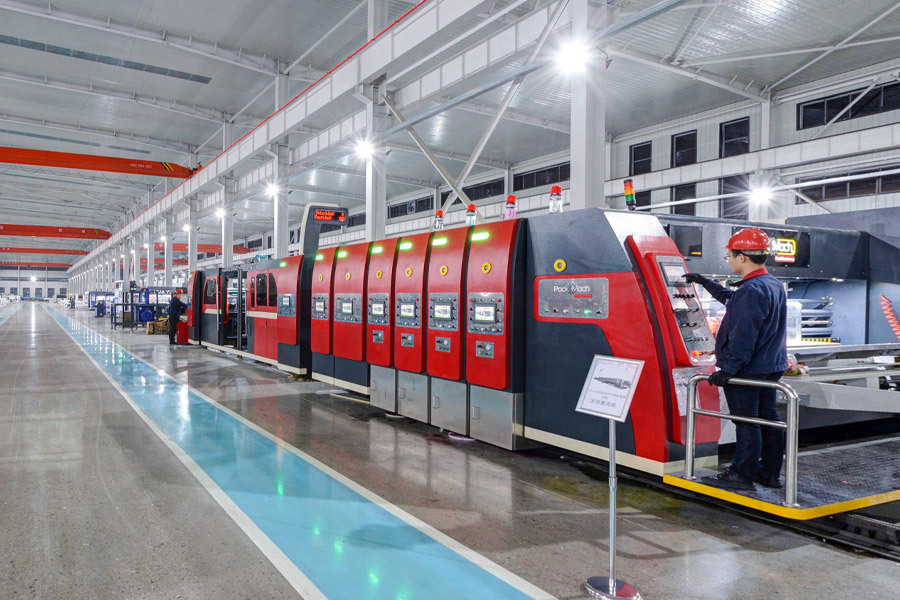
A complete corrugated board production line typically comprises a shaftless mill roll stand, a fingerless single facer (vacuum suction type), a preheater, a double bridge, a gluer machine, a double facer machine, a cut-off machine, a slitter scorer machine, a stacker, and a glue-making system. Each component affects output quality and operational cost — which is why evaluating the full system, not just the headline machine speed, is critical.
Main types of corrugator machines explained
The corrugator machine category is broader than most buyers initially assume. Selecting the wrong type is not just a performance problem — it directly inflates your cost per square metre of board produced.
Single facer machine
A single facer machine produces single-face corrugated board: one flat liner glued to one fluted medium. This output is used as a wrap or cushioning layer rather than a structural board. It is the simplest entry point into corrugated production and suits businesses that supply protective wrapping to furniture, glass, or ceramic manufacturers. Real-world testing shows single facers can achieve speeds of 80–150 metres per minute on standard B and C flute configurations. Their lower capital cost — typically R800,000 to R2.2 million locally — makes them accessible to smaller operations.
Double backer machine and three-ply board production
A double backer machine takes single-face board from the single facer and bonds it to a second flat liner, creating the standard three-ply corrugated sheet used in most carton box making machine outputs. The double backer uses a heated flat-bed press to cure the glue bond under controlled temperature and pressure. Board flatness and glue-line quality are determined here — warping problems almost always trace back to double backer heat settings or moisture imbalance in the liners. This is the machine that separates acceptable board from premium board in competitive South African markets.
Full automatic corrugated board production line
A fully integrated corrugated converting machine combines single facer, double backer, slitter scorer, cut-off, and stacker into one automated flow. Modern high-speed lines from manufacturers like BHS and Fosber reach 400 metres per minute, with AI-assisted tension control and IoT-enabled predictive maintenance as standard features in 2026 models. Five-ply and seven-ply configurations serve heavy export packaging and industrial applications. These systems represent the upper end of industrial corrugating equipment investment — but for a corrugated paper plant running two or three shifts, the unit economics are compelling.
Mini corrugator and flute laminator options
A flute laminator is a distinct but related machine — it laminates pre-formed single-face board onto a flat liner sheet at high speed, commonly used for high-definition litho-laminate packaging. This is the machine referenced in the growing trend of replacing offset printing with inline digital and flexo printing on corrugated board. Mini corrugators, meanwhile, address the South African SME reality: compact footprint, lower steam consumption, and batch flexibility for short-run custom orders.
Single facer vs double backer vs full production line: which is right for South African SMEs?
This is the question most procurement managers in South Africa are actually trying to answer. The honest answer is: it depends on your current volume, your five-year growth projection, and your available floor space — not just your upfront budget.
| Machine type | Output (m/min) | Board layers | Best for | Approx. cost (ZAR) |
|---|---|---|---|---|
| Single facer | 80–150 | 2-ply | Protective wrap, SME entry | R800K – R2.2M |
| Single facer + double backer | 100–200 | 3-ply | Standard carton production | R2.5M – R6M |
| Full 5-ply auto line | 200–400 | 5-ply | High-volume, export cartons | R12M – R35M+ |
| Mini corrugator | 30–80 | 3-ply | Short-run, custom orders | R400K – R1.2M |
Based on real cases from South African corrugated sheet manufacturers, a business producing 15,000–40,000 square metres of board per day typically finds the single facer and double backer combination the most defensible investment. It provides structural three-ply board for standard carton box making machine downstream processes, without the steam infrastructure and floor space demands of a full production line. Of course, there are situations where a mini corrugator is the smarter start — particularly for a converter entering the market on a short-run digital packaging model.
Why flute selection matters as much as machine type
A common industry misconception is that C flute is "universal." In practice, the South African e-commerce packaging surge has made E flute and F flute configurations increasingly relevant — they offer better printability, tighter die-cut tolerance, and lower material cost per box for lightweight products. Selecting a corrugator machine that cannot readily switch between flute profiles limits your commercial flexibility. Always confirm flute-change capability and changeover time with the supplier before signing.
Volume thresholds for justifying a full production line
Industry consensus is that a full automatic corrugated board production line becomes economically justified at sustained outputs above 80,000 square metres per day, running double shifts. Below that threshold, the capital servicing cost per unit of board produced typically exceeds what a well-optimised three-ply line would cost. This is not a rigid rule — financing structure, energy costs, and local labour rates all shift the calculation.
Key specifications and features to evaluate before buying
Speed figures in brochures tell only part of the story. What separates a reliable corrugated packaging solution from an expensive headache is the precision of the supporting systems.
Steam system and energy consumption
Steam is the single largest operating cost in corrugated board production. A poorly designed steam system on a kraft paper corrugator wastes energy through uninsulated pipework, poor condensate recovery, and oversized boiler capacity. In 2026, buyers should demand a declared steam consumption figure per 1,000 square metres of board produced. Leading machines now incorporate waste heat recovery, reducing steam demand by 18–25% compared to 2020-era equipment. Given Eskom's electricity pricing and industrial gas costs in South Africa, this is not a minor detail.
Control systems and IoT readiness
Modern corrugated converting machines ship with PLC control systems and, increasingly, cloud-connected dashboards for real-time monitoring of glue viscosity, web tension, and temperature profiles. Think of it like the difference between flying with instruments and flying blind — operators who can see exactly where a fault is developing can intervene before it becomes a production stoppage. For South African buyers managing multi-shift operations with limited specialist engineering staff on-site, remote diagnostics capability is a practical necessity, not a luxury feature.
"The future of packaging machinery is not faster speeds — it is smarter uptime. Predictive maintenance and real-time quality monitoring will define the leading corrugated operations of this decade." — FEFCO Industry Outlook Report, 2026
Board quality indicators: flatness, bond strength, and moisture
Warping (board curl) remains the most reported quality complaint from corrugated sheet manufacturers in South Africa. It is caused by moisture differential between liner and medium — and it is almost always a machine calibration and paper storage issue, not a design flaw. When evaluating a machine, ask the supplier to demonstrate board flatness across a full paper reel change cycle, not just during a controlled demonstration run. Bond strength testing to SANS/ISO peel standards should be part of your acceptance protocol.
South Africa pricing, financing, and total cost of ownership
This is the section most South African buyers cannot find elsewhere — and it is the information that matters most when presenting a capital expenditure proposal internally.
Local pricing benchmarks in Rand (2026)
Based on recent market intelligence from South African packaging machinery importers and distributors, the following price ranges apply for CIF Durban or Johannesburg delivery, including installation supervision but excluding civil works and boiler infrastructure:
- Entry-level single facer: R800,000 – R1.5 million
- Mid-range single facer + double backer (3-ply, 150 m/min): R3.5 million – R6.5 million
- Full 5-ply automatic production line (200–300 m/min): R14 million – R28 million
- High-speed full line (300–400 m/min, IoT-enabled): R28 million – R45 million+
Import duties and VAT add approximately 20–28% to ex-works Chinese or European prices. Chinese-origin equipment dominates the mid-range segment due to price competitiveness, while European brands (BHS, Fosber, AGNATI) hold the high-speed premium tier.
Financing and leasing options available locally
South African buyers have several structured financing routes. The Industrial Development Corporation (IDC) offers asset finance for packaging manufacturing equipment, with terms up to 84 months and competitive prime-linked rates for qualifying black-owned or export-oriented manufacturers. ABSA Asset Finance and Nedbank Business Banking both provide equipment leasing for industrial packaging machinery — a leasing structure preserves working capital and can be structured as an operating lease to keep the asset off balance sheet. Some machinery suppliers offer vendor financing arrangements through their local distribution partners, typically at 15–24% per annum. Always model the total interest cost over the loan term against a projected cash payback period based on your actual production volume forecast.
SANS standards, environmental compliance, and the shift away from plastic packaging
Why do so many corrugator machine buyers in South Africa underestimate the regulatory dimension of their investment? Partly because the compliance landscape has changed faster than equipment sales conversations have caught up.
Relevant SANS standards for corrugated packaging
The South African National Standards most directly relevant to corrugated board production include SANS 11093 (corrugated fibreboard — specifications), SANS 7965 (performance tests for shipping containers), and SANS 14031 (environmental performance evaluation for manufacturing operations). When selecting a corrugated board production line, your equipment must be capable of producing board that consistently meets the compression strength (ECT) and burst strength (Mullen) benchmarks specified in SANS 11093 for the box grades your customers require. This is not a checkbox — major South African retailers including Shoprite, Pick n Pay, and Woolworths specify SANS-compliant board as a supplier condition.
The plastic replacement opportunity for corrugated packaging
South Africa's draft Extended Producer Responsibility (EPR) regulations and the 2022 plastic bag levy expansion have materially accelerated brand-owner interest in paper-based corrugated packaging solutions as substitutes for shrink-wrap, plastic trays, and foam inserts. This is a genuine commercial opportunity for corrugated paper plant operators investing now. A corrugator machine capable of producing lightweight micro-flute (E or F flute) board opens doors to packaging formats that directly replace plastic in fresh produce, pharmaceutical, and personal care supply chains — sectors actively seeking compliant alternatives in 2026.
Aftersales support, spare parts, and downtime risk in South Africa
Ask any experienced operations manager at a South African corrugated sheet manufacturer what they wish they had investigated more thoroughly before buying — and the answer is almost always: aftersales support.
The real cost of downtime
A corrugated board production line running at 200 metres per minute producing 3-ply board at an average board width of 1,800 mm generates roughly 21,600 square metres of board per hour. At a conservative ex-works board price of R18 per square metre, that is over R388,000 in lost revenue per hour of unplanned downtime. Critical components — corrugating rolls, glue doctor rolls, hot plate assemblies, and drive belts — must be available locally or within a 72-hour airfreight window. This is not overly cautious thinking; it is arithmetic.
Evaluating supplier service capability in South Africa
Before committing to any cardboard box equipment supplier, request the following:
- A list of reference installations currently operating in South Africa (not just Africa — locally).
- Confirmation of local technical support staff — ideally based in Gauteng or Western Cape, with guaranteed on-site response within 48 hours.
- A local spare parts inventory list showing which components are stocked in-country versus imported on demand.
- A structured preventive maintenance schedule with documented service intervals and estimated annual maintenance cost in Rand.
- Remote diagnostic capability — whether the supplier's engineering team can access your machine's control system remotely to pre-diagnose faults before dispatching a technician.
Industry experience suggests that European-branded packaging machinery South Africa suppliers generally offer more robust local service networks than direct-import Chinese machinery, though the cost differential is narrowing as Chinese manufacturers invest in local representation. The middle path — Chinese-engineered equipment supplied and supported by an established South African packaging machinery distributor with local technicians — often represents the best risk-adjusted outcome for mid-size operations.
In summary: a corrugator machine is not simply a capital purchase. It is an operational commitment spanning 15–20 years of production. The procurement decision that optimises for lowest landed price without validating service infrastructure is a decision that frequently costs more over the asset's life than the price saved upfront. Evaluating industrial corrugating equipment through a total cost of ownership lens — capital, energy, maintenance, downtime risk, and compliance readiness — gives procurement managers the most defensible framework for supplier selection in South Africa's competitive packaging market in 2026.
Frequently asked questions
Q: What is the average lifespan of a corrugator machine?
A: A well-maintained corrugator machine typically operates productively for 15 to 20 years. Critical wear components such as corrugating rolls and glue system parts require periodic replacement every 3–5 years depending on throughput. Regular preventive maintenance is the single biggest factor determining longevity.
Q: How much does a corrugator machine cost in South Africa?
A: In 2026, entry-level single facer machines start at approximately R800,000, while mid-range three-ply production lines range from R3.5 million to R6.5 million. Full automatic five-ply production lines are priced from R14 million to R45 million depending on speed and automation level. Prices include CIF Durban delivery but exclude civil and boiler infrastructure.
Q: What flute types can a standard corrugator machine produce?
A: Most mid-range corrugators support A, B, C, and E flute profiles. F and N micro-flutes require specialist corrugating rolls and tighter tension control. Always confirm flute range and changeover time with the supplier, as flute versatility is increasingly important for South African packaging operations serving both retail and e-commerce customers.
Q: Does a corrugator machine need to comply with SANS standards in South Africa?
A: The machine itself is not SANS-certified, but the board it produces must meet SANS 11093 specifications for corrugated fibreboard if your customers — particularly major retailers — require SANS-compliant packaging. Ensure the machine's press and glue system can consistently achieve the compression and burst strength benchmarks your target market demands.
Q: What is the difference between a single facer and a double backer in a corrugated board production line?
A: A single facer machine bonds one fluted medium to one flat liner, producing two-ply board used mainly as wrapping material. A double backer machine then bonds a second flat liner to the single-face board to create structural three-ply corrugated sheet. Both machines working in series form the core of a standard corrugated board production line for carton manufacturing.
Hot Tags:
PREVIOUS:

Contact Us
E-mail:
jimlee0218@huayucartonmachine.com
Phone/WhatsApp:
+86-15226701321
Address:
Dongguang Economic Packing Machine Zone, Cangzhou City, Hebei Province, China

Contact: Mr. Jim Lee


REQUEST QUOTE