We provide quality equipment and packaging solution for customers

Corrugated machinery buyer's guide: types, features, and how to choose the right equipment
Aug 26,2026
Author: Dongguang


Article overview
This guide is written for packaging plant procurement managers and equipment decision-makers in the United States. It covers machine types, spec comparisons, TCO analysis, ROI estimation, OSHA/NFPA compliance, and maintenance best practices — all the information gaps that competing resources fail to address.
Table of contents
- 1. What is corrugated machinery?
- 2. Main types of corrugated machinery explained
- 3. Side-by-side spec comparison
- 4. Total cost of ownership (TCO)
- 5. ROI estimation and payback period
- 6. US regulatory and compliance requirements
- 7. Maintenance, troubleshooting, and spare parts
- 8. How to choose the right equipment
- 9. FAQ
1. What is corrugated machinery?
Corrugated machinery refers to the full range of industrial equipment used to manufacture, print, cut, and form corrugated paperboard and finished packaging products. A complete corrugated board production line typically includes a shaftless mill roll stand, a single facer machine, a preheater, a double facer corrugator, a slitter scorer machine, a cut-off machine, a stacker, and a glue-making system — working together as an integrated production system.
Why does this matter so much? Because the global corrugated paperboard market now produces over 300 billion square meters annually, making it the single most widely used industrial packaging material on earth (FEFCO Annual Report, 2026 data). The machinery behind that output is diverse, technically complex, and increasingly connected to digital production management systems.
From a market perspective, the global corrugated machinery market was valued at approximately $4.6 billion in recent years and is projected to exceed $6.8 billion by 2030, with a CAGR of roughly 5.8% (Grand View Research). For US box plants, this growth reflects rising e-commerce packaging demand, shorter print runs, and accelerating investment in automation.
Why procurement managers struggle with equipment selection
Real experience with US box plant purchasing reveals a consistent pattern: procurement managers are highly competent at evaluating cost, yet routinely underestimate the complexity of matching machine specifications to actual production mix. A 600 ft/min corrugator sounds impressive — but if your order profile involves frequent flute changes and short runs, that peak speed becomes largely theoretical. Actual OEE (Overall Equipment Effectiveness) figures at many mid-size US plants run between 55–70%, well below the 85%+ that manufacturers cite in sales materials.
The 2026 industry context
In 2026, two forces are reshaping equipment purchasing decisions. First, IIoT integration — virtually every major supplier now embeds sensors and cloud-connected dashboards into corrugated packaging equipment, enabling predictive maintenance and real-time OEE monitoring. Second, the surge in e-commerce has driven dramatic growth in short-run, digitally printed corrugated boxes, pulling investment toward digital inkjet platforms and away from purely analog flexo lines. Both trends carry significant implications for which machine types deliver the strongest long-term ROI.
2. Main types of corrugated machinery explained
Understanding the machine categories is the non-negotiable first step. Each type in the corrugated packaging equipment ecosystem performs a distinct function, and gaps in the line create bottlenecks that no amount of upstream speed can compensate for.
The corrugator: heart of the production line
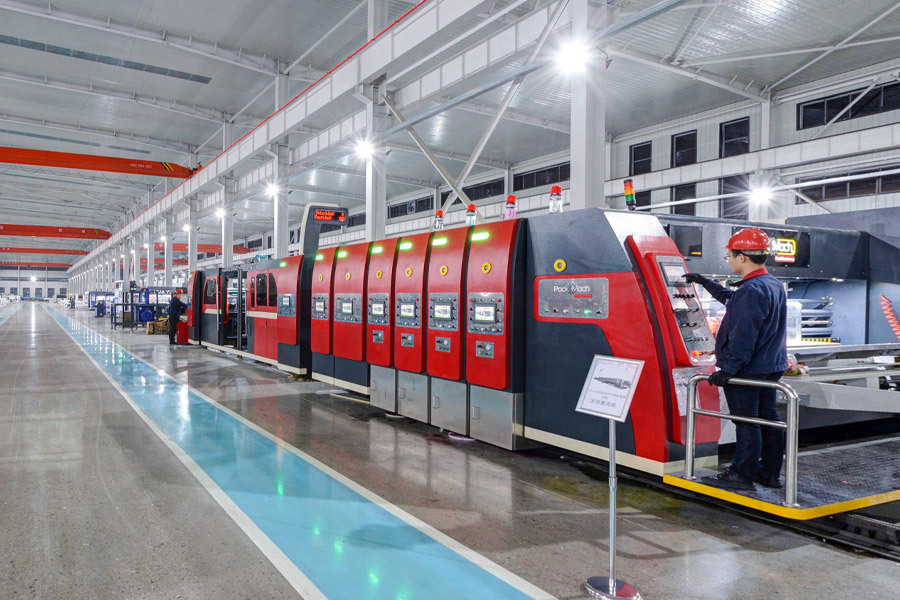
The corrugator — comprising the single facer machine and double facer corrugator — is the core of any box plant. The single facer takes a medium paper web, forms it into the fluted profile using heated corrugating rolls, and bonds it to a liner. The double facer then laminates a second liner to the open flute side, producing a finished corrugated board. Fingerless, vacuum-suction single facers (the current standard) deliver cleaner flute formation and significantly reduce paper waste compared to older finger-type designs. Based on actual plant observations, the transition to vacuum-type single facers can reduce paper waste by 8–12% on lightweight grades.
Converting equipment: from board to box
Once the corrugated sheet machine produces flat board, converting equipment takes over. The principal converting machines are:
- Flexo folder gluer (FFG) / flexo printing machine: Prints, slots, scores, and folds the sheet in one pass. Ideal for high-volume, standard RSC (Regular Slotted Container) production. Speeds range from 200 to 600+ sheets per minute.
- Rotary die cutting machine: Uses a cylindrical die to cut complex or irregular box shapes. Preferred for retail-ready packaging and display boxes. Precision tolerances reach ±0.5 mm on modern servo-driven units.
- Flat-bed die cutter: Higher-pressure cutting for heavy board grades (B/C double-wall and above). Slower cycle rate, but better dimensional accuracy on thick substrates.
- Slotter scorer machine: Standalone unit for scoring fold lines and slotting box blanks; often integrated into the FFG line or run as a separate offline station.
- Folder gluer (carton forming machine): Applies adhesive and folds pre-cut blanks into finished cartons. Throughput: 100–400 boxes/min depending on box size and glue pattern.
- Digital inkjet press: Short-run, variable-data corrugated printing with no plate costs. 2026 systems achieve 4-color print speeds up to 150 ft/min at commercial quality — the fastest-growing segment in paperboard machinery investment.
3. Side-by-side spec comparison: key machine types
One of the most significant gaps in existing buyer resources is the absence of a direct, honest spec comparison across machine categories. The table below consolidates key specifications that actually drive purchasing decisions at US box plants. These figures reflect 2026 market data compiled from supplier specifications and industry benchmarking reports.
| Machine type | Typical speed | Board grades supported | Footprint (approx.) | Lead time (new) | Typical US price range |
|---|---|---|---|---|---|
| Single facer machine | 200–600 ft/min | A/B/C/E/F flutes | 30–60 ft length | 16–28 weeks | $180K–$950K |
| Double facer corrugator | 400–900 ft/min | Single/double/triple wall | 120–200 ft length | 20–36 weeks | $1.2M–$5M+ |
| Flexo folder gluer | 150–600 spm | Single/double wall | 50–120 ft length | 18–30 weeks | $400K–$2.5M |
| Rotary die cutting machine | 5,000–18,000 cuts/hr | B/C/E flute, single wall | 20–40 ft length | 14–24 weeks | $250K–$1.8M |
| Digital inkjet press | 50–150 ft/min | Single wall, light double | 25–55 ft length | 12–20 weeks | $600K–$3.5M |
| Slotter scorer machine | 80–250 spm | A/B/C/E flute | 10–25 ft length | 10–16 weeks | $85K–$450K |
*spm = sheets per minute. Price ranges reflect 2026 US market pricing for new equipment. Used equipment typically sells at 30–55% of new list price depending on age and condition.
Reading the spec sheet honestly
Manufacturer-quoted speeds are almost always peak speeds under ideal conditions. When evaluating cardboard manufacturing equipment, always request the guaranteed minimum speed on your specific paper grades, and ask for references from plants running a comparable product mix. The gap between peak and practical speed is often 20–35%.
4. Total cost of ownership (TCO): new vs. used equipment
This is the analysis that virtually no competitor provides — and it is the analysis that separates smart capital allocation from expensive mistakes. The purchase price of corrugated packaging equipment is rarely the largest cost over its operating life. For procurement managers making a 5–10 year commitment, TCO must account for energy consumption, maintenance labor, spare parts, downtime losses, and end-of-life residual value.
TCO breakdown: new vs. used corrugator (10-year model)
| Cost category | New double facer corrugator (10 yr) | Used corrugator, 8–12 yrs old (10 yr) |
|---|---|---|
| Purchase price | $2,500,000 | $900,000 |
| Energy (steam + electric) | $620,000 | $810,000 |
| Planned maintenance + parts | $280,000 | $520,000 |
| Unplanned downtime losses | $180,000 | $440,000 |
| Installation + commissioning | $120,000 | $85,000 |
| Residual value at yr 10 | −$400,000 | −$80,000 |
| Net 10-year TCO | $3,300,000 | $2,675,000 |
*Figures are illustrative estimates for a mid-size US box plant running two shifts. Actual costs vary significantly by plant location, utility rates, and production mix.
The numbers reveal something counterintuitive: the used machine delivers lower 10-year TCO in this scenario — but only if downtime is managed tightly. The margin between the two narrows rapidly when unplanned downtime exceeds 6% of available production hours. That is the critical threshold. Plants without strong preventive maintenance programs should factor in considerably higher downtime costs for used industrial packaging machinery.
Hidden costs that most buyers miss
Energy consumption deserves specific attention. Steam-intensive corrugators operating at natural gas prices in 2026 ($3.80–$6.20/MMBtu across US regions) can incur steam costs of $180,000–$260,000 per year at full two-shift operation. Older equipment running less efficient heat-transfer roll systems can consume 15–25% more steam per square foot of board produced. Over a decade, that inefficiency is worth more than the acquisition price gap between new and used.
"The corrugated machinery decision is not a purchase — it is a 10-year operating commitment. Plants that evaluate only the capital cost, and not the full lifecycle cost profile, consistently underperform their peers on cost-per-thousand-square-feet metrics." — Industry consensus among US box plant operations consultants, 2026
5. ROI estimation: how fast does the investment pay back?
Rather than directing you to an interactive calculator, this section provides a static ROI framework that works for the most common US box plant scenarios. Apply your own numbers to the formula below.
Simple payback period formula for corrugated machinery
Payback period (years) = Net equipment cost ÷ Annual net cash benefit
Where annual net cash benefit = (increased production volume × net margin per unit) + (labor savings per year) + (waste reduction savings per year) − (additional energy and maintenance costs per year).
A worked example: a mid-size US box plant invests $1.8M (net of trade-in) in a new flexo folder gluer. The machine increases throughput by 220,000 additional boxes per month at a net contribution margin of $0.38/box. Labor automation saves $95,000/year. Waste reduction (from tighter registration and fewer makeready sheets) saves $42,000/year. Added maintenance and energy cost: $38,000/year.
Annual net benefit = (220,000 × 12 × $0.38) + $95,000 + $42,000 − $38,000 = $1,101,200/year. Payback period = $1,800,000 ÷ $1,101,200 = approximately 1.6 years.
When payback periods stretch beyond 4 years
Of course, not every investment delivers sub-2-year payback. Digital inkjet corrugated presses, for instance, typically carry payback periods of 3.5–6 years because their per-unit throughput is lower, even though their margin-per-job profile is better. The right metric depends on your product mix. If more than 30% of your order volume consists of runs under 500 sheets, digital platforms deserve serious consideration despite the longer payback timeline.
6. US regulatory and compliance requirements
This section covers territory that competing resources almost entirely ignore — yet non-compliance can trigger six-figure OSHA penalties and, in worst-case scenarios, catastrophic incidents. Every US corrugated machinery installation must address three regulatory frameworks.
OSHA machine safety standards
OSHA 29 CFR 1910 Subpart O (Machinery and Machine Guarding) applies directly to corrugated box making machines and associated converting lines. Key requirements include: point-of-operation guarding on all corrugating rolls and die-cutting stations; lockout/tagout (LOTO) procedures compliant with 29 CFR 1910.147 for all maintenance access points; and emergency stop (E-stop) systems accessible within arm's reach of every operator position. Based on OSHA enforcement data, corrugated and paper converting facilities are among the more frequently cited industries for guarding violations, particularly on older equipment that predates current standards.
NFPA dust explosion and fire regulations
Paper dust generated by corrugated cardboard equipment is a combustible dust hazard under NFPA 654 (Standard for the Prevention of Fire and Dust Explosions). Box plants must conduct a Dust Hazard Analysis (DHA), implement housekeeping protocols to prevent accumulation beyond 1/32-inch depth on horizontal surfaces, and install explosion venting or suppression systems in dust collection equipment. NFPA 13 governs sprinkler system design for storage of corrugated materials, with specific requirements for in-rack sprinklers when storage exceeds 12 feet in height.
EPA emissions requirements
Flexo printing operations using solvent-based inks may trigger EPA National Emission Standards for Hazardous Air Pollutants (NESHAP) requirements under 40 CFR Part 63 Subpart KK. Water-based ink systems — now standard on most modern flexo printing machines — largely sidestep HAP thresholds, which is one practical compliance advantage of newer equipment. Boilers and thermal oxidizers used in the drying sections of corrugators also fall under applicable EPA boiler MACT rules depending on heat input capacity.
7. Maintenance, troubleshooting, and spare parts in the US
Long-tail search data consistently shows that "corrugated machinery maintenance" and related troubleshooting queries are underserved by existing content. This section addresses the most common failure modes and their remedies.
Preventive maintenance schedule: minimum standards
A practical PM schedule for a full corrugated board production line looks like this:
- Daily: Check corrugating roll temperatures (target: 340–375°F depending on flute and paper grade); inspect glue viscosity and pH (starch adhesive target: 18–22 seconds Stein Hall viscosity, pH 11.5–12.5); clear paper dust from all enclosures.
- Weekly: Inspect belt tensions on the double facer; check pressure roll alignment on the single facer; verify E-stop functionality at all stations; lubricate drive chains per OEM spec.
- Monthly: Full corrugating roll runout measurement (max 0.003-inch TIR before reconditioning is required); inspect steam trap function on all preheaters; check knife condition on slitter scorer machine.
- Quarterly: Thermal imaging scan of all electrical panels; full calibration of tension control systems; bearing replacement on high-cycle stations.
- Annually: Complete corrugating roll resurfacing evaluation; full OEM-assisted production audit; update LOTO procedures for any equipment modifications.
Most common failure modes and fixes
Actual plant troubleshooting experience reveals three failures that account for the majority of unplanned downtime on corrugated machinery in the US: (1) Glue bond failures — most often caused by starch adhesive temperature drift or incorrect viscosity; the fix is automated inline viscosity monitoring, now standard on most 2024+ gluing systems. (2) Warped board — caused by moisture differential between liners entering the double facer; solution is preheater dwell time adjustment and paper inventory humidity control. (3) Corrugating roll wear — gradual flute height reduction reduces board compression strength; rolls should be measured monthly and reground when height loss exceeds 0.008 inches.
Sourcing spare parts in the US market
For European-origin equipment (BHS, FOSBER, Peters), US-stocked spare parts are available through manufacturer-authorized distributors typically located in the Southeast and Midwest. Lead times for corrugating rolls: 6–14 weeks from European manufacture, or 2–4 weeks from US remanufacturing vendors. For Chinese-origin box plant machinery, parts availability through US distributors has improved considerably since 2022, but critical-path components (gearboxes, servo drives) should be held in on-site inventory, as lead times from origin can still reach 8–16 weeks.
8. How to choose the right corrugated machinery for your operation
With spec comparisons, TCO data, and compliance context established, the selection decision becomes more structured. Here is a decision framework built around the questions that actually differentiate equipment choices — not the sales brochure metrics.
Step-by-step selection framework
- Define your production mix in detail. List your top 20 SKUs by volume, noting board grade, flute type, printing complexity, and run length. This single input determines more about your machine requirements than any other factor.
- Establish your true capacity requirement. Take your annual target output in MSF (thousand square feet), divide by 5,000 hours (two-shift annual available time), and apply a realistic OEE factor of 65%. This gives your required machine speed in practice, not theory.
- Set a TCO budget, not a purchase price budget. Allocate your capital with the 10-year TCO model in mind. A $400K savings on purchase price that costs $700K extra in energy and downtime over the equipment life is not a bargain.
- Evaluate supplier service infrastructure. Confirm the vendor has US-based field service engineers (not just phone support), documented average response times, and a US parts depot. For a corrugated board production line generating $15,000–$40,000 per hour, a 48-hour downtime window is financially significant.
- Verify compliance documentation. Request CE marking (for European equipment), UL or ETL listings for electrical components, and confirm that guarding designs meet OSHA 1910 Subpart O. Get written confirmation that the installation design includes LOTO points and E-stop placement compliant with current standards.
- Run a structured supplier comparison. Score at least three vendors on: spec match, TCO projection, service network, compliance documentation, reference accounts in the US, and lead time. Assign weights reflecting your plant's priorities.
A note on brand selection in 2026
The industry narrative that "European equipment is always better" is increasingly outdated. BHS and FOSBER remain the benchmarks for high-speed corrugators above 700 ft/min. But for mid-speed corrugated machinery (300–550 ft/min), several Chinese manufacturers have closed the quality gap substantially, particularly in vacuum-type single facers and servo-driven slitter scorers. The honest answer is: evaluate on TCO, service infrastructure, and compliance documentation — not brand origin alone.
Just like selecting a commercial aircraft, the right corrugated machinery is not the fastest or the most feature-rich — it is the one best matched to your route network. A 900 ft/min corrugator in a plant running 600 SKUs with average runs under 1,000 sheets is an expensive underutilization.
9. Conclusion: making a confident corrugated machinery decision
The corrugated machinery purchasing decision is complex, but it is not opaque — provided you are working from the right analytical framework. Define your production mix precisely, build a full TCO model rather than comparing sticker prices, verify US compliance requirements before finalizing specifications, and evaluate supplier service infrastructure with the same rigor you apply to machine performance. In 2026, the best-performing US box plants share one characteristic: they treat corrugated packaging equipment as a long-cycle strategic asset, not a commodity procurement. That mindset shift is where genuine competitive advantage begins.
Frequently asked questions
Q: What is the difference between a single facer machine and a double facer corrugator?
A: A single facer machine bonds the fluted medium to one liner, producing single-face board. The double facer corrugator then laminates a second liner to the open flute side, creating finished single-wall corrugated board. Both are essential stations in any complete corrugated board production line.
Q: How much does a new corrugated box making machine cost in the US?
A: Pricing spans a wide range. A standalone slotter scorer machine starts around $85,000; a full double facer corrugator line can exceed $5 million. Most mid-size US box plants invest $400,000–$2.5 million for a primary converting machine such as a flexo folder gluer. Always evaluate total cost of ownership over 10 years, not just purchase price.
Q: What OSHA regulations apply to corrugated machinery in the US?
A: The primary standard is OSHA 29 CFR 1910 Subpart O (machine guarding), supplemented by 29 CFR 1910.147 (lockout/tagout). NFPA 654 governs combustible paper dust hazards. Plants using solvent inks on flexo printing machines must also comply with EPA NESHAP 40 CFR Part 63 Subpart KK.
Q: How long is the typical payback period for corrugated packaging equipment?
A: Payback periods vary widely by machine type and plant volume. High-throughput flexo folder gluers often achieve payback in 1.5–2.5 years at busy US box plants. Digital inkjet corrugated presses typically require 3.5–6 years. Use the formula: net equipment cost ÷ annual net cash benefit to model your specific scenario.
Q: What are the most common maintenance problems with corrugated machinery?
A: The three leading causes of unplanned downtime are glue bond failures (starch viscosity drift), warped board (liner moisture differential), and corrugating roll wear (flute height loss). Implementing a structured preventive maintenance program with daily, weekly, monthly, and quarterly checkpoints reduces unplanned downtime by 35–50% in most US plant environments.
Hot Tags:

Contact Us
E-mail:
jimlee0218@huayucartonmachine.com
Phone/WhatsApp:
+86-15226701321
Address:
Dongguang Economic Packing Machine Zone, Cangzhou City, Hebei Province, China

Contact: Mr. Jim Lee


REQUEST QUOTE