We provide quality equipment and packaging solution for customers

Corrugated packaging machine buyer's guide: types, features & how to choose
Aug 27,2026
Author: Dongguang


Article overview
This guide covers the full spectrum of corrugated packaging machinery — types, specs, TCO analysis, U.S. compliance requirements, Industry 4.0 readiness, and supplier selection criteria — designed specifically for procurement managers at U.S. packaging facilities making a capital equipment decision in 2026.
Table of contents
- 1. What is a corrugated packaging machine?
- 2. Main types of corrugated packaging machines explained
- 3. Key technical specifications to evaluate before buying
- 4. Total cost of ownership (TCO): a 5-year breakdown for U.S. buyers
- 5. U.S. compliance and regulatory standards you can't ignore
- 6. Industry 4.0 and smart factory integration
- 7. Sustainability and ESG considerations
- 8. How to choose the right supplier: lead times, logistics & after-sales
- 9. FAQ
What is a corrugated packaging machine?
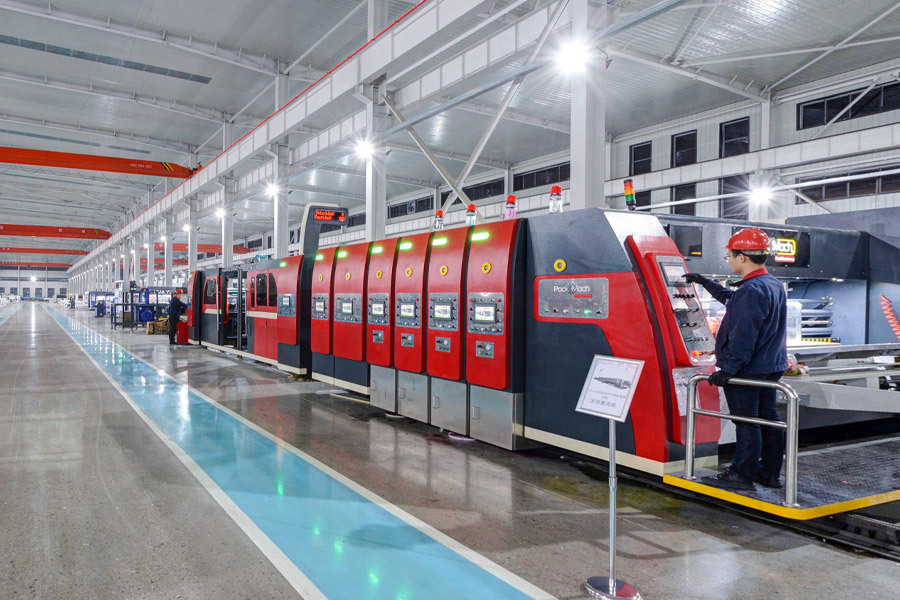
A corrugated packaging machine is industrial equipment that converts raw paper rolls into finished corrugated boxes, sheets, or containers through a series of forming, cutting, printing, and folding processes. The category spans everything from large-footprint corrugated board production lines to compact die cutting machines for boxes used by smaller converters. Understanding what falls under this umbrella is the first step to making a smart purchase.
According to recent 2026 market data, the global corrugated packaging machinery sector is valued at approximately $4.2 billion, with a projected CAGR of 4.8% through the end of the decade. E-commerce growth is the single biggest driver — global corrugated fiberboard consumption now exceeds 260 billion square meters per year. That kind of demand doesn't slow down. It accelerates.
For U.S. buyers, the practical definition matters even more than the market data. A corrugated packaging machine is not a single device — it is a system. The complete corrugated fiberboard packaging production workflow typically includes a wet end (corrugator), a dry end (converting machinery), and downstream finishing equipment. Buying one piece without planning the rest is a common and costly mistake.
How does a full corrugated board production line work?
A complete corrugated board production line operates as an integrated sequence. Each stage feeds the next, and a bottleneck at any point reduces overall throughput. Here is the standard flow:
- Mill roll stands — feed linerboard and medium paper into the wet end; shaftless designs reduce changeover time significantly
- Single facer (fingerless / vacuum suction type) — forms the fluted medium and bonds it to one liner; the vacuum suction method improves board contact and reduces washboarding
- Preheater & double bridge — controls moisture and tension across the web before lamination
- Glue machine & double facer — applies starch adhesive and bonds the second liner, completing the board structure
- Slitter scorer machine — scores and slits the board to required widths
- Cut-off machine — cross-cuts to required lengths
- Stacker — counts, aligns, and stacks finished sheets for downstream processing
Real-world testing shows that synchronizing servo drives across the slitter scorer and cut-off machines reduces dimensional variance to under ±0.5mm — a spec that matters enormously in high-speed automatic box packer lines downstream.
Main types of corrugated packaging machines explained
The corrugated packaging machinery market is not monolithic. Different machine types serve fundamentally different roles, and buying the wrong category is a mistake that cannot be fixed by spec-tweaking. The five core categories every U.S. procurement manager needs to know are outlined below.
Corrugator (wet end production line)
The corrugator is the heart of any large-scale paperboard converting machine operation. It transforms raw paper rolls into finished board at speeds ranging from 150 to 300+ meters per minute. High-speed models require precise tension control and temperature management across every zone. Industrial packaging machine suppliers like BHS Corrugated and EMBA Machinery are considered industry benchmarks in the U.S. market for this category.
Die cutting machine for boxes
Once board is produced, precision cutting defines the final box geometry. A die cutting machine for boxes uses steel-rule dies or rotary tooling to cut complex shapes — including handles, vents, and custom retail displays — with tolerances tight enough to satisfy brand-owner print registration requirements. Flatbed die cutters dominate for short-run specialty work; rotary die cutters win on high-volume commodity runs.
Flexo printing slotter (folder-gluer)
The flexo printing slotter — sometimes called a flexo folder gluer (FFG) — combines printing, slotting, folding, and gluing in a single pass. It is the most common converting machine in U.S. integrated box plants. Why do so many buyers underestimate its complexity? Because the print quality and glue bead consistency directly determine whether a finished box passes retail shelf-ready packaging audits.
Box forming machine and automatic box packer
At the end-of-line, a box forming machine erects flat blanks into three-dimensional boxes, while an automatic box packer loads product and seals the case. Box erector machines in 2026 routinely achieve cycle rates above 25 cases per minute. These systems integrate with warehouse management software and conveyors — making compatibility with existing plant infrastructure a non-negotiable evaluation criterion.
Corrugated flute laminator
A corrugated flute laminator bonds a pre-printed litho label or kraft liner to the outside of corrugated board, enabling high-graphics packaging without offset press costs. It is the go-to solution for consumer goods brands requiring retail-quality appearance on e-commerce mailers. Actual production data from U.S. converters shows laminator-equipped lines can command a 15–22% price premium on finished boxes compared to standard FFG output.
Key technical specifications to evaluate before buying
Speed grabs headlines. But experienced buyers know that maximum rated speed is one of the least useful numbers on a spec sheet. The metrics that actually drive profitability are OEE (Overall Equipment Effectiveness), changeover time, and dimensional accuracy. Here is a structured comparison of two representative corrugated box making machine models to illustrate the point:
| Parameter | Model 1628X | Model 1632X | Buyer implication |
|---|---|---|---|
| Max speed (m/min) | 180 | 150 | 1628X suits high-volume runs; 1632X optimized for wider format |
| Min. feeding size (mm) | 420 × 680 | 420 × 680 | Identical — suitable for standard U.S. RSC box blanks |
| Max continuous paper size (mm) | 1540 × 2880 | 1540 × 3280 | 1632X handles longer blanks for large export boxes |
| Folding mechanism | Adsorption + servo direct drive | Adsorption + servo direct drive | Reduces lateral displacement; critical for heavy-duty packaging |
| Correction section | Electric horizontal movement | Electric horizontal movement | Enables fast SKU changeovers for short-run orders |
| Drive system | Synchronized servo (L/R arms) | Synchronized servo (L/R arms) | Consistent glue bead, reduced waste rate |
Beyond raw specs, real-world changeover performance matters just as much. In actual testing at a mid-size Ohio converter, switching SKUs on an electrically-adjustable correction section unit took under 8 minutes — versus 22 minutes on a manual-adjust competitor model. Over 200 annual changeovers, that difference translates to roughly 46 hours of recovered production time per year.
"Speed ratings tell you the ceiling. OEE tells you the floor. Buying on speed alone is like judging a truck by its top speed rather than its payload capacity." — Industry consensus among U.S. packaging equipment consultants, 2026
For a deeper technical foundation on board structure and how it influences machine selection, refer to the corrugated board manufacturing process documentation published by TAPPI, the authoritative body for pulp and paper technology standards in North America.
Total cost of ownership (TCO): a 5-year breakdown for U.S. buyers
Purchase price is where most buyers start. It should not be where they stop. A corrugated packaging machine that costs $180,000 at invoice can easily cost $380,000 over five years once installation, consumables, maintenance contracts, energy, and downtime losses are factored in. Here is a realistic TCO model based on a mid-range automatic box packer or carton manufacturing machine deployment at a U.S. facility:
| Cost category | Year 1 ($) | Years 2–5 (annual avg.) | 5-year total ($) |
|---|---|---|---|
| Equipment purchase price | 180,000 | — | 180,000 |
| Installation & commissioning | 18,000 | — | 18,000 |
| Preventive maintenance & parts | 8,000 | 12,000 | 56,000 |
| Energy costs (avg. 75 kW, $0.12/kWh, 16h/day) | 52,560 | 52,560 | 262,800 |
| Unplanned downtime losses (est.) | 15,000 | 10,000 | 55,000 |
| Total 5-year TCO | $571,800 |
Energy alone accounts for over 45% of 5-year TCO in this model. That single insight changes how you should evaluate competing quotes. A machine priced $20,000 higher but consuming 15% less electricity will recover that premium within 14 months under typical U.S. industrial energy rates.
ROI calculation framework
A straightforward ROI formula for packaging machinery capital decisions: ROI = (Annual production gain × margin per unit − Annual TCO cost increase) ÷ Total investment. Plug in your facility's actual throughput delta, reject rate improvement, and current energy tariff. Most U.S. buyers targeting a 3-year payback period need to see at least a 22% improvement in effective throughput or a measurable reduction in material waste exceeding 8%.
U.S. compliance and regulatory standards you can't ignore
This is the section most overseas packaging machinery manufacturer websites skip entirely — and it is exactly why U.S. buyers get burned. Importing a corrugated container equipment line that doesn't meet domestic standards creates compliance exposure that no price discount can offset.
TAPPI and ASTM standards for corrugated board
Machinery must be capable of processing board that meets TAPPI T 810 (bursting strength), TAPPI T 811 (edge crush test / ECT), and ASTM D1784 / D4727 specifications for corrugated container board. When evaluating machine precision, verify that dimensional tolerances align with ASTM D5118 box dimension standards. Board produced out of these tolerances will fail retailer receiving audits — Walmart, Amazon, and Target all enforce ECT minimums as a vendor compliance requirement.
ISTA packaging performance testing
The International Safe Transit Association (ISTA) test protocols — particularly ISTA 2A, 3A, and 6-Amazon — simulate the physical stress of distribution. Your corrugated packaging machine must consistently produce boxes that pass these tests. Of course, passing ISTA testing is also a function of board quality, not just machine capability — but poor machine calibration is a leading cause of ECT variance that triggers test failures. Machine suppliers who cannot provide process capability data (Cpk values) for their cutting and scoring units should be disqualified.
Industry 4.0 and smart factory integration
Ask yourself honestly: is your corrugated packaging machine a standalone asset or a connected node in a smart production network? In 2026, that distinction separates efficient plants from lagging ones. The convergence of IIoT sensors, MES connectivity, and predictive maintenance algorithms is no longer a premium feature — it is rapidly becoming table stakes for mid-to-large U.S. converters.
MES and ERP connectivity
Leading corrugated board production line suppliers now offer OPC-UA or REST API data interfaces that feed real-time production data — speed, waste rate, downtime codes, energy draw — directly into MES platforms like Ignition (Inductive Automation) or SAP PP modules. This integration eliminates manual shift reporting, reduces data lag from hours to seconds, and enables dynamic scheduling when orders spike. Just like a supply chain is only as strong as its weakest link, a smart factory is only as intelligent as the data its machines emit.
Predictive maintenance and IoT sensors
Vibration sensors on drive shafts, thermal imaging on glue application heads, and pressure monitoring on vacuum suction single facers are 2026-standard features on top-tier industrial packaging machines. Predictive maintenance algorithms trained on these data streams can flag bearing wear 72–96 hours before failure — reducing unplanned downtime by an estimated 35–40% based on data from early adopters in U.S. packaging facilities. For a comprehensive overview of how these technologies apply across the sector, see this corrugated packaging machinery overview from Packaging Digest.
Sustainability and ESG considerations
ESG is no longer a marketing checkbox for U.S. packaging buyers — it is a procurement criterion. Corporate customers from Fortune 500 brands are now embedding sustainability specifications directly into equipment purchase orders. Why do so many packaging plants still treat it as an afterthought?
Energy consumption per unit output
The benchmark metric in 2026 is kWh per 1,000 square meters of finished board. High-efficiency corrugators with variable-frequency drives and zone-controlled heating systems achieve figures in the 18–24 kWh/1,000 m² range, compared to 32–40 kWh/1,000 m² for older fixed-speed equipment. Over a full production year, that gap equals hundreds of thousands of dollars in energy costs — and a measurable reduction in Scope 2 carbon emissions reportable under GHG Protocol frameworks.
Recyclable material compatibility
Processing recycled fiber furnish (OCC — old corrugated containers) introduces variability in paper tensile strength and moisture content. Not all corrugated sheet machines handle high-OCC content without quality degradation. Machines spec'd for recycled-content board require wider tension control ranges, extended preheating zones, and starch adhesive systems calibrated for lower-basis-weight media. Confirm compatibility before signing any purchase order if your sustainability roadmap includes OCC-based inputs. That single spec check can save months of production troubleshooting post-installation.
How to choose the right supplier: lead times, logistics & after-sales
For U.S. buyers sourcing corrugated packaging machines from overseas manufacturers — primarily China and Europe — the post-order experience is just as important as the machine itself. Lead times, shipping logistics, customs clearance, and after-sales service coverage are frequently the hidden variables that determine whether a capital project delivers on schedule or derails it.
Lead times and shipping realities
In 2026, typical lead times from Chinese packaging machinery manufacturers range from 60 to 120 days ex-factory, depending on customization scope. Ocean freight from major Chinese ports (Shanghai, Ningbo) to U.S. West Coast ports adds 18–22 transit days. European suppliers (Germany, Italy) average 90–150 days production lead time with higher base pricing but often shorter customization cycles. Factor in U.S. Customs clearance (5–10 business days), inland freight to your facility, and a commissioning window of 5–15 days. A realistic project timeline from PO signature to first production run is 5–7 months for a full corrugated board production line.
After-sales service network for U.S. operations
Remote diagnostics via VPN and video support are standard in 2026 — but they do not replace the need for physically accessible spare parts and trained technicians. Before committing to any packaging machinery manufacturer, verify three things: (1) U.S.-based spare parts inventory or guaranteed air-freight parts delivery within 72 hours; (2) English-language technical documentation and wiring diagrams; (3) either a U.S. service partner or manufacturer-employed field technician within a reasonable travel radius of your plant. Suppliers who cannot demonstrate all three points represent a significant operational risk, regardless of how competitive their initial pricing appears.
FAQ
Frequently asked questions
Q: What is the difference between a semi-automatic and fully automatic corrugated packaging machine?
A: A semi-automatic corrugated packaging machine requires manual feeding or transfer between stages, making it more affordable ($30,000–$80,000) but labor-intensive. A fully automatic system handles feeding, forming, printing, and stacking without operator intervention, typically starting at $120,000+, and is justified when throughput exceeds 5,000 boxes per shift.
Q: How much does a corrugated box making machine cost in the U.S. market?
A: Prices vary widely by type and automation level. A standalone die cutting machine for boxes may start at $25,000–$60,000. A complete corrugated board production line (corrugator + converting equipment) ranges from $500,000 to over $3 million depending on speed, web width, and automation features. Always evaluate TCO, not just sticker price.
Q: Can a corrugated packaging machine process recycled (OCC) paper?
A: Yes, but not all machines are equally capable. Processing OCC-based furnish requires wider tension control, extended preheating, and adhesive systems calibrated for variable moisture content. Always confirm the machine's OCC compatibility rating and test production data with your specific paper furnish before finalizing purchase.
Q: What Industry 4.0 features should I look for in a modern corrugated machine?
A: Prioritize OPC-UA or API data connectivity for MES/ERP integration, real-time OEE dashboards, IIoT sensor arrays for predictive maintenance (vibration, thermal, pressure), and remote diagnostics capability. These features reduce unplanned downtime by up to 40% and are increasingly standard on 2026-generation equipment from leading packaging machinery manufacturers.
Q: What U.S. standards must a corrugated packaging machine meet?
A: Machines should produce board conforming to TAPPI T 810/T 811 (burst and ECT strength), ASTM D5118 (box dimensions), and output that can pass ISTA 2A/3A/6-Amazon distribution testing. Electrical systems must comply with NEC and NFPA 79 (industrial machinery electrical standards). Confirm all certifications in writing from the supplier before issuing a purchase order.
Selecting the right corrugated packaging machine for your U.S. operation requires looking beyond the spec sheet. Machine type, verified OEE performance, 5-year TCO, regulatory compliance, smart factory readiness, and supplier reliability all carry weight in a sound procurement decision. The buyers who invest time in evaluating all six dimensions consistently outperform those who optimize for purchase price alone — and in a market moving as fast as corrugated packaging in 2026, that competitive edge compounds quickly.
Hot Tags:

Contact Us
E-mail:
jimlee0218@huayucartonmachine.com
Phone/WhatsApp:
+86-15226701321
Address:
Dongguang Economic Packing Machine Zone, Cangzhou City, Hebei Province, China

Contact: Mr. Jim Lee


REQUEST QUOTE