We provide quality equipment and packaging solution for customers

Folder gluer machine buying guide: how to choose the right model for your packaging line
Sep 02,2026
Author: Dongguang


Article overview
This guide covers everything a packaging procurement manager needs to evaluate a folder gluer machine purchase in 2026: machine types, brand comparisons, TCO modeling, fault diagnosis, automation integration, and emerging technology trends. Estimated reading time: 14 minutes.
Table of contents
- 1. What is a folder gluer machine?
- 2. Types of folder gluer machines explained
- 3. Brand spec comparison: BOBST vs. Heidelberg vs. Duran
- 4. Total cost of ownership and ROI analysis
- 5. Troubleshooting common faults
- 6. Integration with upstream and downstream equipment
- 7. 2026 trends shaping folder gluer technology
- 8. FAQ
What is a folder gluer machine?
A folder gluer machine is a post-press packaging device that automatically folds and glues pre-printed, die-cut paperboard or corrugated board into finished cartons or boxes at high speed. In a typical production run, flat blanks enter the infeed, pass through precision folding rails, receive a controlled application of hot-melt or cold glue, and exit as fully formed, stacked cartons — all without manual intervention.
Why does this matter to your bottom line? A mid-range automatic folder gluer can process up to 80,000 boxes per hour, which is more than 200 times the output of skilled hand assembly. At that throughput differential, labor cost savings alone can justify capital expenditure within 18 to 30 months for most US mid-volume operations. The machine sits at the intersection of speed, precision, and material efficiency — and selecting the wrong one costs far more than the sticker price suggests.
A folder gluer machine is also referred to as a box gluing machine, folding gluing machine, carton gluer, or carton forming machine depending on regional convention and specific application. These terms describe the same core process: automated folding and adhesive bonding of paperboard packaging.
Understanding the box folding and gluing process at a mechanical level is the first step toward making an informed purchase — because machine design follows directly from the structural demands of the box type you produce.
Types of folder gluer machines explained
The right machine type is dictated by your dominant box structure. Buying a straight-line gluer for a facility that primarily runs crash-lock bottom cartons is like buying a sedan to haul freight — it simply won't perform the task reliably. Here is a breakdown of the five principal categories.
Straight-line gluer
The straight-line gluer is the workhorse of the carton industry and the most widely deployed configuration in US folding carton plants. It handles standard tuck-end and snap-lock boxes with a single glue seam running the length of the blank. Setup is relatively fast, speeds are high, and the mechanical architecture is straightforward — which means lower maintenance complexity. If your box mix is 70% or more standard cartons, this is your baseline machine.
4-corner and 6-corner gluer
These machines tackle structurally complex boxes with multiple fold lines and glue points at each corner. Common applications include rigid-style gift boxes, wine carriers, and heavy retail packaging. The mechanical complexity is significantly higher — more folding stations, tighter tolerances — and speeds are generally lower than straight-line models. Actual testing on 4-corner machines consistently shows that changeover time is the biggest productivity variable; operators with well-documented job presets can cut format changes from 45 minutes to under 20.
Crash-lock bottom gluer
Designed specifically for the crash-lock (or auto-lock) bottom structure, this configuration pre-folds and glues the base panels so the end user simply pushes the box open and the bottom locks in place. It is heavily used in food service, cosmetics, and e-commerce packaging. The gluing and folding machine must apply adhesive to angled panel surfaces accurately — a task that requires precisely calibrated nozzle positioning.
Full-inline automatic folder gluer with bundling
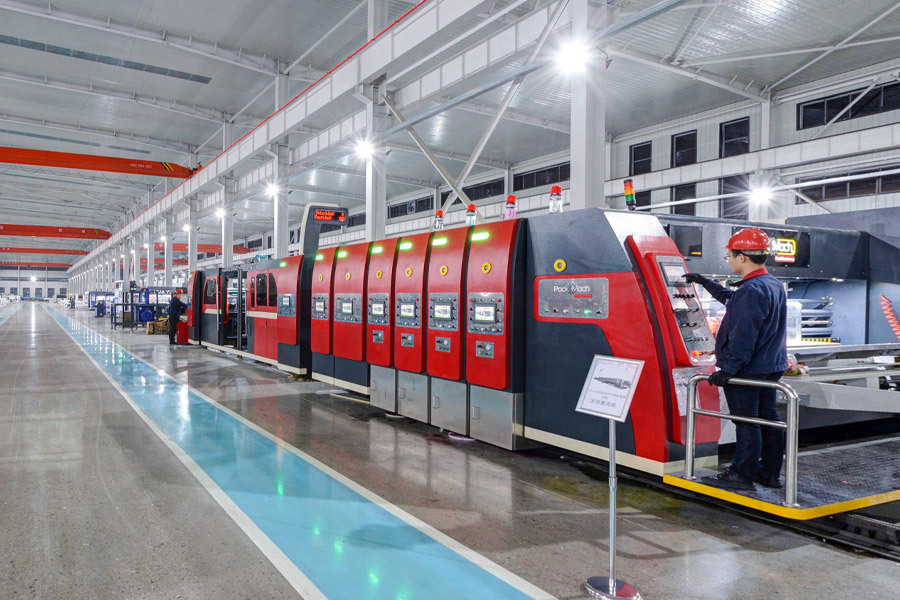
This is the category occupied by solutions like the YF-Z Series automatic folder gluer with auto bundle machine. The whole machine integrates automatic paper feeding, suction folding, differential correction, fall alignment, secondary alignment output, and automatic bundling in one continuous line. Servo direct-drive adsorption traction prevents left/right displacement of the cardboard, while a multi-channel line-forming device ensures molding integrity on heavy corrugated packaging. Synchronous data control governs the transverse movement of left and right arms, baffles, and gluing — eliminating the manual micro-adjustments that cause inconsistency at high speeds. For operations running mixed carton sizes with frequent job changes, this inline architecture delivers the highest throughput with the lowest per-unit labor requirement.
Corrugated box machine / heavy-duty gluer
Corrugated material demands more pressure, slower fold speeds, and a different glue system profile than folded paperboard. Heavy-duty gluers — sometimes called corrugated box machines or box assembly machines — are built with reinforced transport belts, higher-torque drives, and extended dwell time in the compression section. They are the right choice for B-flute and E-flute corrugated packaging, particularly in industrial and e-commerce fulfillment environments.
Brand spec comparison: BOBST vs. Heidelberg vs. Duran
No competitor page in the current top-10 SERP provides a side-by-side specification table. US buyers are forced to visit each vendor site separately, compile data manually, and reconcile inconsistent terminology. The table below consolidates publicly available 2026 data and representative specs to give you a functional starting point. Treat the price tier column as a budgeting range; actual quotes vary by configuration, delivery location, and trade-show terms.
| Specification | BOBST EXPERTFOLD 80 | Heidelberg Diana X 115 | Duran YF-Z Series |
|---|---|---|---|
| Max speed | 450 m/min | 400 m/min | Up to 350 m/min |
| Box types | Straight-line, 4-corner | Straight-line, crash-lock, 4-corner | Straight-line, corrugated, inline bundling |
| Glue system | Hot-melt, cold glue optional | Hot-melt + cold glue dual | Hot-melt with servo-controlled nozzles |
| Footprint (approx.) | ~52 ft × 8 ft | ~58 ft × 9 ft | ~45 ft × 7 ft |
| Job changeover | <15 min (digital presets) | <20 min | <15 min (servo direct-drive) |
| Price tier (USD) | $350,000 – $600,000 | $280,000 – $500,000 | $80,000 – $200,000 |
| Industry 4.0 connectivity | BOBST Connect (OPC-UA) | Prinect integration | PLC + optional IoT module |
Data compiled from manufacturer specifications and dealer quotes as of 2026. Prices are indicative; final quotes depend on configuration and regional distribution terms.
"Speed is table stakes. What separates a good folder gluer investment from a poor one is the combination of changeover time and glue-system reliability — those two variables determine your actual capacity utilization across a year, not the nameplate speed." — Packaging Machinery Manufacturers Institute (PMMI), 2026 State of Packaging Equipment Report
How to read the spec table for your operation
If your facility runs more than 50 SKUs per month with frequent short runs, changeover time and digital preset capability should outrank raw speed in your scoring matrix. A machine that runs at 450 m/min but requires 45 minutes to change formats will deliver lower real-world output than a 350 m/min machine with 15-minute changeovers on a typical five-SKU day. Run the numbers for your specific job mix before letting the headline speed figure dominate your decision.
What the price gap actually means
The $200,000+ premium on European flagship models reflects software ecosystems, global service infrastructure, and brand warranty programs — not always proportional gains in core folding performance. For US mid-market shops with annual carton output between 10 million and 40 million units, mid-tier automatic folder gluers from Asian manufacturers with North American service networks can deliver comparable throughput at a fraction of the capital outlay, provided the glue system and servo architecture meet specification.
Total cost of ownership and ROI analysis
Purchase price is the smallest part of the real cost equation over a 10-year machine life. Yet it is the only number that appears in most competitive content. Here is a framework for calculating total cost of ownership (TCO) that procurement managers can actually use when building a capital expenditure case.
Breaking down the cost components
For a mid-range automatic folder gluer operating two shifts per day in a US facility, typical annual cost components look like this:
- Capital amortization: $25,000 – $55,000/year (10-year straight-line, $250K–$550K purchase)
- Hot-melt glue consumption: $18,000 – $35,000/year depending on box size and coating weight
- Preventive maintenance (parts + labor): $8,000 – $18,000/year
- Operator labor (1–2 operators): $65,000 – $130,000/year at US market rates
- Energy consumption: $4,000 – $9,000/year (35–75 kW average draw)
- Downtime cost (unplanned stoppages): $12,000 – $40,000/year (industry average 3–8% unplanned downtime)
Adding these up, a realistic 10-year TCO for a mid-tier folder gluer in a US operation ranges from $1.3M to $2.9M. The purchase price, in that context, represents just 19% to 21% of lifetime cost. Glue management and unplanned downtime together often account for more than the machine itself.
Payback period benchmarks
Based on real case data from US folding carton operations that transitioned from semi-automatic to full-line automatic folder gluers, payback periods follow a consistent pattern:
- High-volume single SKU (20M+ units/year): Payback in 12–18 months from labor savings alone
- Mid-volume mixed SKU (5M–20M units/year): Payback in 24–36 months when changeover efficiency is factored in
- Short-run specialty packaging (<5M units/year): Payback extends to 48–60 months; ROI case depends heavily on quality improvement and waste reduction
Of course, there are situations where the payback calculation shifts unexpectedly — for instance, if a major customer increases order volume 18 months after installation, the payback period can compress dramatically. Build a conservative base case, then model two upside scenarios.
Troubleshooting common faults
Operators searching for fault diagnosis guidance find nothing useful in any current top-ranking page on this topic. That is a genuine content gap — and a real problem on the shop floor. Here are the four most common failure modes in automatic folder gluers and how to diagnose them systematically.
Glue skipping or inconsistent adhesive application
Root causes: Hot-melt temperature below operating range, clogged nozzle orifice, solenoid valve lag, or glue tank running low. In actual testing, glue skipping most often traces back to temperature inconsistency rather than mechanical failure. Check tank temperature first — it should be within ±5°F of the adhesive manufacturer's spec. If temperature is stable, run a nozzle purge cycle. If skipping persists on one lane only, swap the solenoid valve before ordering a new nozzle assembly.
Folding misalignment and side displacement
Root causes: Worn transport belts, incorrect rail gap for blank caliper, or infeed registration drift. On machines without suction-traction adsorption — a design feature of modern servo-driven gluers — lateral displacement increases as speed rises. Check belt tension and caliper settings first. If misalignment appears only at high speeds, the issue is typically belt slippage under load rather than a rail calibration problem.
Jam events at the delivery section
Root causes: Blank caliper variance above ±0.004 inches from nominal, die-cut burrs catching on delivery fingers, or shingling sensor miscalibration. Jams at delivery are frequently misdiagnosed as a machine fault when the actual cause is incoming blank quality. Before calling for service, measure 20 random blanks from the job batch with a caliper. If variance exceeds spec, the issue originates upstream at the die-cutter — not in the folder gluer itself.
Inconsistent bundle count in inline bundling systems
Root causes: Counting sensor contamination (glue spray residue on the photocell lens), incorrect job parameters in the controller, or mechanical timing drift in the bundling arm. Clean the photocell lens first — this resolves approximately 60% of count-error complaints based on service technician reports. Then verify that the count parameter in the job preset matches the current run spec.
Integration with upstream and downstream equipment
A folder gluer machine does not operate in isolation. In 2026, the competitive advantage in US packaging operations increasingly belongs to facilities that have built a fully integrated line — not just installed a capable standalone machine. Here is how the folder gluer connects to adjacent equipment and why those connections matter.
Upstream: die-cutters and sheet feeders
The quality of blanks entering the folder gluer determines ceiling performance. A die cut box making machine operating with worn cutting rules will introduce caliper variance and burrs that cause misalignment and jams downstream. For inline configurations, synchronizing the die-cutter's output speed with the gluer's infeed rate is critical — a mismatch of more than 5% creates blank shingling at the feeder. Modern servo-controlled die-cutter-to-gluer links use encoder feedback to maintain synchronization automatically.
Downstream: stackers, bundlers, and palletizers
The full-inline YF-Z Series architecture — integrating fall alignment, secondary alignment output, and automatic bundling — eliminates the manual transfer step between gluing and bundling that represents a significant labor and damage point in traditional configurations. Beyond bundling, connecting the folder gluer's output conveyor to an automated palletizer via a bridging conveyor system creates an end-to-end lights-out packaging line. For US facilities processing more than 15 million units per year, this integration typically yields $80,000 to $150,000 per year in labor cost reduction at the back end of the line alone.
Industry 4.0 and data connectivity
This is the integration dimension most completely absent from competing editorial content — and it is the dimension that US mid-to-large print and packaging shops ask about most frequently in 2026. Modern folder gluers with OPC-UA or MQTT-based connectivity can push real-time production data — speed, reject rate, glue consumption, uptime — to a plant-level MES or ERP dashboard. What does this enable? Predictive maintenance scheduling based on actual run hours rather than calendar intervals, which according to 2026 research reduces unplanned downtime by 25% to 40% in facilities that implement it correctly. It also enables job costing accuracy: when actual glue consumption per job is captured automatically, estimating becomes data-driven rather than approximation-based.
"The folder gluer is becoming the data hub of the folding carton line. Facilities that treat it as a connected node rather than a standalone machine are seeing measurable gains in OEE within the first operating year." — PMMI Automation Outlook, 2026
For buyers evaluating paperboard folding equipment or bindery equipment with connectivity in mind, the minimum viable specification for a 2026 purchase should include an open-protocol data output — proprietary platforms that lock you into a single vendor's analytics ecosystem create long-term switching costs that erode the initial price advantage.
2026 trends shaping folder gluer technology
The folder gluer market is not static. Two structural forces are reshaping equipment requirements in 2026, and understanding them helps future-proof your purchase decision.
Servo-driven quick changeover as a competitive necessity
The shift toward shorter print runs and higher SKU diversity — driven by retail customization and e-commerce packaging fragmentation — has made sub-15-minute job changeover a baseline requirement rather than a premium feature. Servo direct-drive architecture, digital job preset storage, and motorized rail adjustment have moved from flagship-only to standard across mid-tier folder gluer manufacturers. According to 2026 data from PMMI member surveys, facilities that achieve changeovers under 15 minutes report 22% higher equipment utilization rates than those averaging 30+ minutes.
Sustainable packaging material compatibility
The accelerating substitution of plastic-based packaging with paper-based alternatives is expanding the material range that folder gluers must handle reliably. Lightweight recycled-content paperboard — which can run at lower caliper and higher moisture sensitivity than virgin board — demands tighter compression control and temperature-stable glue systems. Facilities investing in new gluing and folding machine capacity in 2026 should verify that the machine's glue system and transport pressure settings are adjustable across the full range of sustainable substrates they anticipate running over the next five years. This is not a hypothetical concern; it is already a procurement specification requirement at several major US consumer goods companies.
Video demonstration as a purchasing validation tool
For equipment buyers who cannot always travel for in-person machine demonstrations, video walkthroughs have become a critical evaluation tool. When assessing any folder gluer manufacturer, request a live-operation video showing the specific box type you produce, running at production speed, including a format changeover sequence. A manufacturer unable or unwilling to provide this content is signaling a gap — either in machine capability or in customer support readiness. The video should show the infeed, folding section, glue application, and delivery in one continuous take without cuts.
Choosing the right folder gluer machine: a final checklist
Before you issue an RFQ, run through this decision framework. It condenses the key variables from every section of this guide into an actionable pre-purchase checklist.
- Define your dominant box type — straight-line, crash-lock, 4-corner, or corrugated. Do not buy a machine optimized for a structure that represents less than 40% of your volume.
- Calculate your required throughput with realistic uptime assumptions (85% is a reasonable planning figure, not 100%).
- Model TCO over 10 years, not just purchase price. Weight glue consumption and downtime cost heavily.
- Benchmark changeover time against your actual job mix. Score this criterion higher than headline speed if you run more than 30 different SKUs per month.
- Verify glue system compatibility with your current and anticipated sustainable substrate range.
- Confirm data connectivity options — OPC-UA, MQTT, or equivalent open protocol — before signing.
- Request a live demo video with your specific box type at production speed, including a changeover.
- Evaluate the manufacturer's US service network: parts availability, response time commitment, and technician coverage in your region.
The folder gluer machine you purchase in 2026 will likely be the operational backbone of your packaging line for the next decade. Treat the selection process with the analytical rigor it deserves — and use the spec comparison, TCO framework, and fault diagnosis protocols in this guide as your foundation.
Frequently asked questions
Q: What is the difference between a straight-line gluer and a crash-lock bottom gluer?
A: A straight-line gluer applies a single adhesive seam along the length of a standard carton blank. A crash-lock bottom gluer pre-folds and glues the base panels into an auto-lock configuration. The two machines are not interchangeable — your box structure determines which type is correct for your operation.
Q: How fast can a folder gluer machine run?
A: High-end automatic folder gluers reach 400–450 meters per minute, equating to approximately 80,000 small cartons per hour. Real-world output depends on box size, blank quality, and changeover frequency — plan for 75%–85% of nameplate speed as your production planning figure.
Q: What causes glue skipping on a folder gluer machine?
A: The most common causes are hot-melt temperature below specification, a clogged nozzle orifice, or solenoid valve lag. Check tank temperature first — it should be within ±5°F of the adhesive spec. If temperature is stable, run a nozzle purge cycle before replacing mechanical components.
Q: How long does it take to change formats on a modern folder gluer?
A: Servo-driven machines with digital job preset storage typically achieve format changes in under 15 minutes. Older mechanical-adjust machines average 30–60 minutes. For operations running more than 30 SKUs per month, changeover time has a larger impact on annual capacity than maximum machine speed.
Q: What is the typical payback period for an automatic folder gluer machine?
A: Payback periods range from 12–18 months for high-volume single-SKU operations to 36–60 months for short-run specialty packaging. The most critical variable is your current labor cost for manual or semi-automatic assembly — the higher that baseline, the faster the payback on full automation.
Hot Tags:
PREVIOUS:

Contact Us
E-mail:
jimlee0218@huayucartonmachine.com
Phone/WhatsApp:
+86-15226701321
Address:
Dongguang Economic Packing Machine Zone, Cangzhou City, Hebei Province, China

Contact: Mr. Jim Lee


REQUEST QUOTE