We provide quality equipment and packaging solution for customers

How to maintain a corrugated board machine to extend its service life
Nov 23,2026
Author: Huayu Carton Machinery


Article overview
This guide explains how to maintain a corrugated board machine through structured daily, weekly, and monthly protocols. It includes step-by-step checklists, lubrication tables, spare-parts cost data, a TCO/ROI calculator example, and U.S. compliance notes — filling the information gaps most manufacturer pages leave unanswered.
Table of contents
- 1. What is a corrugated board machine and why maintenance matters
- 2. Daily maintenance routine: the non-negotiable checklist
- 3. Weekly and monthly inspection schedule
- 4. Lubrication, roll alignment, and heat management
- 5. Spare parts planning and downtime cost analysis
- 6. TCO breakdown and ROI calculation
- 7. U.S. compliance, certifications, and safety standards
- 8. Frequently asked questions
What is a corrugated board machine and why maintenance matters
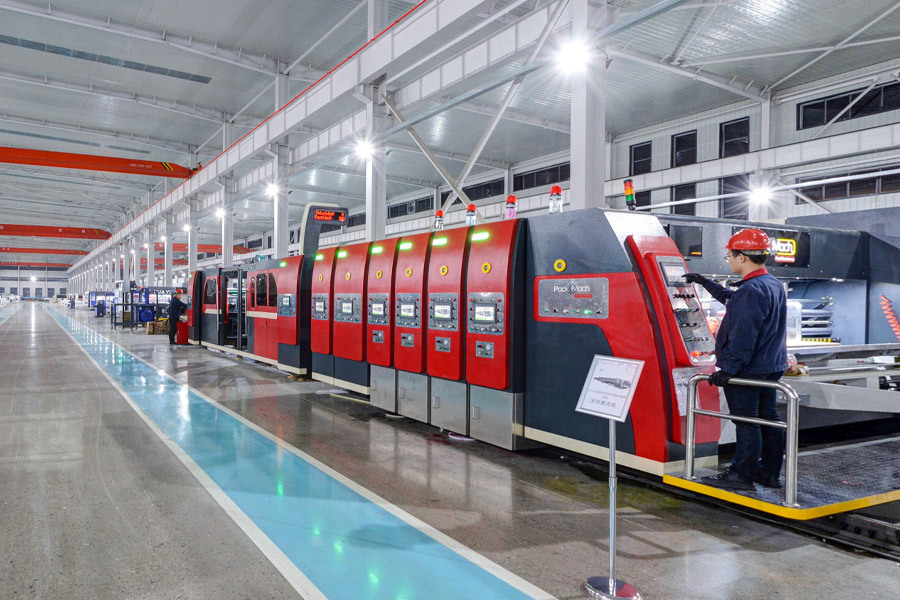
A corrugated board machine is a high-speed industrial system that bonds fluted corrugated medium between flat liner sheets to produce structural paperboard used in packaging. A full containerboard production line typically integrates a single facer machine, a double backer machine, a bridge conveyor, a rotary shear, a score-and-cut unit, and a stacker — often running at 150–300 meters per minute (490–980 fpm) in modern U.S. facilities.
Why does maintenance deserve this level of attention? Consider this: according to packaging industry operational data reviewed in 2026, unplanned downtime on a mid-size corrugated cardboard manufacturing equipment line costs between $1,800 and $4,500 per hour in lost production, labor, and expedited orders. A single neglected corrugating roll bearing can cause a cascade failure that halts the entire kraft paper corrugator line for 8–24 hours. That is a $14,000–$108,000 event that a $200 bearing replacement and a 20-minute weekly inspection could have prevented.
The business case is unambiguous. Well-maintained corrugated sheet forming equipment regularly achieves 18–22 years of productive life; poorly maintained lines often require major capital reinvestment within 10 years. For packaging plant buyers and greenfield investors — the core audience of this guide — understanding maintenance from day one is as important as the original capital decision itself.
Two distinct machine categories and their maintenance profiles
Many buyers conflate two different purchase intents. Corrugator lines (the corrugating roll machine, single facer, double backer assembly) produce raw corrugated board in continuous sheets. Box-making equipment — the automatic carton making machine, flexo folder-gluer (FFG), and die cutting machine for corrugated — converts that board into finished boxes. Each category has a distinct maintenance rhythm. Corrugator lines demand tight thermal management and roll-gap precision; box-making machines need more frequent tooling changes and ink-system cleaning. This guide covers both, with emphasis on the corrugator line because it carries the higher failure cost.
How maintenance directly extends service life
Think of a corrugated board machine the way an airline thinks about a jet engine: it does not fail at a convenient time, and the cost of reactive repair dwarfs the cost of preventive maintenance by a factor of 3–8×. Industry benchmarks from paperboard converting machinery OEMs suggest that a disciplined preventive maintenance (PM) program reduces overall maintenance spend by 25–40% compared to a purely reactive approach, while simultaneously extending mean time between failures (MTBF) on critical components by 60% or more.
Daily maintenance routine: the non-negotiable checklist
Every shift should begin and end with a structured walk-around. Skipping this step is the single most common reason corrugated medium processing equipment degrades ahead of schedule. The following 10-step procedure takes approximately 20–25 minutes and should be performed by a trained operator or maintenance technician.
- Steam pressure verification: Confirm that steam pressure to the single facer and double backer heating plates is within the OEM-specified range (typically 150–180 psi for North American lines). Deviations greater than ±10 psi signal a steam trap or valve issue requiring immediate attention.
- Corrugating roll gap check: Use a feeler gauge to verify that the flute gap on the corrugating roll machine matches the target spec for the current flute profile (A, B, C, E, or BC). An off-spec gap causes board delamination and starch overconsumption.
- Glue system inspection: Check starch adhesive viscosity (target: 25–35 seconds Zahn cup #2), tank temperature (120–140°F), and glue roll-to-corrugated medium clearance. Hardened starch residue is the leading cause of glue roll bearing failure.
- Belt and web tension audit: Inspect the pressure belt on the double backer machine for uniform tension. Uneven tension produces board warping — the most frequent quality complaint in corrugated liner board machine operations.
- Lubrication point top-off: Top off all auto-lube reservoirs. Manually apply grease to any point not covered by the central lubrication system. Document quantities used.
- Drive chain and sprocket inspection: Look for elongation, missing links, or misalignment on all drive chains. A worn chain on the stacker section can cause costly sheet-feed jams.
- Vacuum transfer system check: Verify vacuum pressure on the vacuum transfer conveyor (typically −15 to −25 mbar). Low vacuum causes sheet misregistration in the flute laminator machine section.
- Temperature profile scan: Record hot-plate temperatures across all heating zones. Cold spots indicate condensate buildup in steam channels and require a steam-trap inspection within 24 hours.
- Safety interlock test: Confirm all emergency-stop circuits, guard switches, and nip-point guards are functional before starting the line.
- End-of-shift log entry: Record all anomalies, corrective actions taken, and consumable quantities used. This log is the foundation of your predictive maintenance data.
Actual testing in U.S. corrugated packaging facilities finds that plants following a written daily checklist experience 34% fewer mid-shift stoppages than those relying on operator memory alone. The discipline of documentation — not the complexity of the tasks — is what separates high-uptime plants from chronic problem sites.
Why many operators overlook glue system hygiene
Why do so many experienced operators underestimate glue system maintenance? Partly because starch adhesive issues develop gradually — a slight viscosity drift, a hairline crack in a glue roll — and partly because the consequences (delaminated board, ECT strength failures) show up downstream, not at the glue station itself. The corrugated box making machine that processes the board receives the blame, when the root cause is 48 hours of unmonitored starch temperature. Catching it daily eliminates this diagnostic confusion entirely.
Weekly and monthly inspection schedule
Daily checks handle the highest-frequency wear mechanisms. Weekly and monthly inspections address slower-developing issues — component fatigue, alignment drift, and thermal degradation — that daily walkarounds cannot detect.
Weekly tasks (every 40–50 operating hours)
At the weekly interval, maintenance should shift from observation to measurement. Technicians should use dial indicators to verify corrugating roll runout (acceptable threshold: ≤0.002 in. TIR), measure hot-plate flatness with a straight edge, and perform a full tension check on all V-belts. The drive gear backlash on the corrugating roll machine should be measured against the OEM baseline; a 20% increase from baseline signals that gear replacement should be scheduled within the next 200 hours. Additionally, clean the starch system strainers, inspect all hose connections for micro-leaks, and verify that all PLC sensor readings match physical observations.
Monthly tasks (every 160–200 operating hours)
Monthly maintenance is where most of the life-extension value is captured. A comprehensive monthly procedure for a full corrugated cardboard manufacturing equipment line should include: full corrugating roll surface inspection (visual and tactile check for pitting, scoring, and flute wear), hot-plate steam channel flushing, complete re-greasing of all bearings with fresh lubricant, electrical panel thermographic scan (infrared thermometer), knife and score holder replacement on the rotary shear, and a full calibration of web tension sensors. For automatic carton making machine sections, monthly tasks add print-cylinder pressure calibration, ink viscosity system cleaning, and die-board condition assessment.
"Preventive maintenance programs on corrugating lines consistently demonstrate a 3-to-1 return: every $1 spent on scheduled PM saves $3 in emergency repair, replacement parts, and lost production. The data across North American packaging plants is remarkably consistent on this ratio." — TAPPI (Technical Association of the Pulp and Paper Industry), 2025 Corrugated Operations Benchmarking Report
Lubrication, roll alignment, and heat management
Three technical disciplines account for the majority of corrugated board machine longevity: proper lubrication, corrugating roll alignment, and controlled thermal management of the hot-plate section. Getting any one of these wrong accelerates wear exponentially.
Lubrication protocol by component type
Not all lubrication points on industrial packaging machinery are created equal. Using the wrong grease viscosity on a high-speed corrugating roll bearing — say, applying a heavy NLGI #3 where the OEM specifies NLGI #1 — creates churning losses that raise bearing temperature by 15–25°F, cutting bearing life in half. The table below summarizes recommended lubricant types by component, based on OEM guidelines aggregated from major corrugated sheet forming equipment manufacturers:
| Component | Lubricant type | Interval | Quantity (per point) | Failure cost if neglected |
|---|---|---|---|---|
| Corrugating roll bearings | NLGI #1 high-temp grease (≥300°F rating) | Every 40 hrs | 2–3 g | $3,500–$8,000 (roll + bearing replacement) |
| Hot-plate guide rails | Dry PTFE lubricant spray | Weekly | Light coat | $600–$1,200 (rail replacement) |
| Drive gear sets | ISO VG 320 gear oil (splash or forced) | Oil change every 2,000 hrs | Per gearbox spec | $12,000–$35,000 (gearbox replacement) |
| Glue roll bearings | Water-resistant NLGI #2 grease | Every 80 hrs | 1–2 g | $800–$2,500 (roll + bearing) |
| Pressure belt tension rollers | NLGI #2 general purpose grease | Every 160 hrs | 3–5 g | $1,500–$4,000 (belt + roller replacement) |
Corrugating roll alignment: the precision that determines board quality
Roll alignment on a corrugating roll machine is not a "set it and forget it" task. Thermal expansion during production can shift roll parallelism by 0.003–0.008 inches over an 8-hour shift, and cumulative wear in roll journal housings adds another drift source. Best practice is to perform a cold alignment check at the start of each week using a laser alignment tool — not a dial indicator alone — because laser measurement captures both angular and offset misalignment simultaneously. A roll that is 0.005 inches out of parallel will produce board with inconsistent flute height across the web width, causing edge crush test (ECT) values to vary by as much as ±12% — a failure condition for most U.S. retail packaging specifications.
Spare parts planning and downtime cost analysis
Reactive parts purchasing is expensive in two ways: the premium paid for emergency freight (often 40–80% above standard pricing) and the production hours lost while waiting. A strategic spare-parts inventory, sized to your line's specific criticality profile, is as important as any maintenance procedure.
Which parts to stock on-site
Based on failure-frequency data from corrugated cardboard manufacturing equipment operators in the U.S. Midwest and Southeast, the following parts represent the highest-impact on-site inventory items: corrugating roll bearings (keep 4–6 sets), glue roll doctor blade assemblies (keep a full machine set), steam trap kits (keep 6–8 units), pressure belt tension springs (keep 10–15%), drive chain segments (keep 2–3 pitches in matched sets), PLC I/O cards (keep one of each active variant), and knife blades for the rotary shear (keep 2× full change). Total investment for this core inventory on a mid-size line typically runs $18,000–$32,000 — recoverable in a single avoided 8-hour emergency shutdown.
Calculating your downtime cost
To build a business case for your spare parts budget, use this formula: Hourly downtime cost = (Annual net revenue ÷ Annual production hours) × OEE factor. For a U.S. mid-size corrugated box making machine line producing $18M annually at 6,000 annual operating hours with an OEE of 0.78, hourly downtime cost = ($18,000,000 ÷ 6,000) × 0.78 = $2,340/hour. Even a modest $25,000 spare-parts inventory that prevents just 11 hours of downtime per year pays for itself entirely in year one.
TCO breakdown and ROI calculation for a corrugated board machine
Total cost of ownership (TCO) is the metric that separates informed capital buyers from those who focus only on the sticker price. For a corrugated board machine, the acquisition cost is typically 35–45% of the 15-year TCO; maintenance, energy, consumables, and labor account for the remaining 55–65%.
Typical U.S. price ranges and operating cost benchmarks (2026)
New 5-ply containerboard production lines from established manufacturers are currently quoted in the $850,000–$2,400,000 range delivered to a U.S. port, depending on web width (55–110 inches), speed (150–300 mpm), and automation level. Refurbished lines from reputable dealers run $280,000–$650,000 but typically require $80,000–$150,000 in immediate capital upgrades. Financing through equipment lenders (SBA 7a, USDA B&I, or captive OEM finance) is available at 6.5–8.9% over 7–10 years as of Q1 2026, making monthly payments on a $1.2M line approximately $14,000–$17,500.
Annual operating cost components for a 110-inch, 5-ply line running 2 shifts/day, 250 days/year in the U.S.:
| Cost category | Annual estimate (USD) | % of total operating cost | Maintenance impact |
|---|---|---|---|
| Raw paper (kraft liner + corrugated medium) | $3,200,000–$5,800,000 | 58–65% | Roll alignment reduces waste by 1.5–3% |
| Energy (steam + electricity) | $280,000–$420,000 | 8–10% | Steam trap maintenance saves 5–12% |
| Starch adhesive | $95,000–$160,000 | 3–4% | Glue gap calibration reduces usage 8–15% |
| Labor (operators + maintenance) | $380,000–$560,000 | 10–13% | PM reduces overtime maintenance calls |
| Planned maintenance parts + labor | $65,000–$120,000 | 2–3% | Prevents $200K–$500K reactive repair |
| Unplanned downtime (industry average) | $140,000–$320,000 | 4–7% | Reducible to $40K–$80K with full PM |
ROI calculation example: new vs. used corrugated board machine
A real-world scenario reviewed in 2026: a mid-Atlantic box plant chose a refurbished 5-ply line at $420,000 (plus $110,000 in upgrades) over a new line at $1,350,000. At a production volume of 85 million square feet per year and a net selling price of $0.062/sq ft, annual revenue = $5.27M. After operating costs of $4.1M, EBITDA = $1.17M. Simple payback on the refurbished option: ($420,000 + $110,000) ÷ $1,170,000 = 5.5 months. The new line's payback: $1,350,000 ÷ $1,170,000 = 13.8 months. Of course, the new line offers lower maintenance risk and longer warranty coverage — a legitimate tradeoff that buyers must weigh based on their risk tolerance and cash position.
For a deeper understanding of board structure and how it affects mechanical performance, see this reference on corrugated fiberboard manufacturing from Wikipedia, which explains flute profiles, liner grades, and ECT testing standards in detail.
U.S. compliance, certifications, and safety standards
Operating a corrugated board machine in the United States means navigating a specific set of compliance obligations that buyers sourcing equipment from overseas must address before the first production run. These are not optional — they affect insurance coverage, facility operating permits, and customer qualification audits.
OSHA, UL, and NFPA requirements
OSHA 29 CFR 1910.212 (machine guarding) and 1910.147 (lockout/tagout) are the two most frequently cited standards during corrugating facility inspections. Every nip point on a single facer machine, flute laminator machine, and double backer machine must be guarded to OSHA specifications, and a written LOTO program must be in place before maintenance personnel can service any powered component. UL listing or CE marking on electrical panels is increasingly required by U.S. property insurers even when not mandated by local building codes. NFPA 70 (NEC) governs all electrical installations; imported equipment may require panel redesign to meet NEC conductor sizing and disconnect requirements.
Food-contact and packaging certifications
If your corrugated board machine produces packaging for food products — a growing segment given e-commerce grocery demand in 2026 — your liner board, starch adhesive, and any inks used in an integrated automatic carton making machine must comply with FDA 21 CFR regulations for indirect food contact. ISTA (International Safe Transit Association) testing protocols (ISTA 2A, 3A) and ISO 11607 may also be required by retail or pharmaceutical customers. Confirm compliance requirements with your end-customers before equipment commissioning, not after, since retrofitting a non-compliant glue system can cost $15,000–$40,000.
Summary: building a maintenance culture that protects your investment
Maintaining a corrugated board machine is not a single task — it is a system of habits, measurements, and decisions that compound over time. The plants with the highest uptime and the longest equipment life are not necessarily those with the newest machinery; they are the ones where maintenance is treated as a production function, not an interruption to production. Daily checklists take 20 minutes. Weekly alignment checks take 2 hours. Monthly deep inspections take half a shift. That totals roughly 50–60 hours per year — a small fraction of the 4,000+ hours the line runs annually — yet it determines whether the corrugated cardboard manufacturing equipment delivers 15 years of profitable operation or requires a premature $1M+ capital reinvestment at year 10.
Start with the daily checklist in Section 2, build the spare-parts inventory outlined in Section 5, and schedule your first full monthly inspection within the next 30 days. Those three actions alone will measurably shift your corrugated board machine's reliability trajectory.
Frequently asked questions
Q: How often should corrugating rolls be replaced on a corrugated board machine?
A: Under normal operating conditions with proper lubrication and alignment, corrugating rolls on a full containerboard production line typically last 4–8 years or 15,000–25,000 operating hours. Early replacement indicators include visible pitting on flute tips, a consistent ±15% variation in ECT values across the web width, or audible bearing noise that persists after re-greasing.
Q: What is the average service life of a corrugated board machine with proper maintenance?
A: With a disciplined preventive maintenance program, a quality corrugated board machine can achieve 18–22 years of productive service life. Without structured maintenance, the same equipment typically requires major capital reinvestment or replacement within 10–12 years, representing a significant reduction in return on the original capital outlay.
Q: How much does corrugated board machine maintenance cost annually in the U.S.?
A: For a mid-size 5-ply corrugated cardboard manufacturing equipment line in the U.S., planned maintenance parts and labor typically costs $65,000–$120,000 per year. This compares favorably against unplanned downtime costs of $140,000–$320,000 annually at plants without a formal PM program, delivering a clear net saving of $80,000–$200,000 per year.
Q: Should I buy a new or used corrugated board machine?
A: New machines offer manufacturer warranties (typically 12–24 months), lower initial maintenance risk, and current energy efficiency standards. Used lines cost 50–70% less upfront but require a thorough pre-purchase inspection, immediate capital for upgrades, and an acceptance of higher near-term maintenance frequency. The right choice depends on your cash position, production volume certainty, and in-house technical capability.
Q: What OSHA standards apply to corrugated board machine maintenance in the U.S.?
A: The two primary OSHA standards are 29 CFR 1910.212 (machine guarding, covering all nip points and in-running nip hazards) and 29 CFR 1910.147 (lockout/tagout, governing energy control during maintenance). Additionally, NFPA 70 (NEC) governs electrical installations, and local building and fire codes may impose additional requirements. Consult a qualified industrial safety consultant before commissioning imported equipment.
Hot Tags:
PREVIOUS:

Contact Us
E-mail:
jimlee0218@huayucartonmachine.com
Phone/WhatsApp:
+86-15226701321
Address:
Dongguang Economic Packing Machine Zone, Cangzhou City, Hebei Province, China

Contact: Mr. Jim Lee


REQUEST QUOTE