We provide quality equipment and packaging solution for customers

Automatic carton packing line: how to choose the right system for your production
Aug 03,2026
Author: Huayu Carton Machinery


Article overview
This guide is written for manufacturing procurement managers, plant engineers, and operations directors evaluating automated packaging solutions in 2026. It covers system selection criteria, TCO benchmarks, integration architecture, troubleshooting strategies, and compliance requirements — the exact content gaps that most competitor articles leave unfilled.
Table of contents
- 1. What is an automatic carton packing line?
- 2. System types: which configuration fits your production?
- 3. Buyer's selection criteria: speed, footprint, product type, and budget
- 4. Total cost of ownership (TCO) and ROI analysis
- 5. Integration with upstream and downstream equipment
- 6. Troubleshooting and uptime optimization
- 7. Industry-specific applications and compliance
- 8. FAQ
What is an automatic carton packing line?
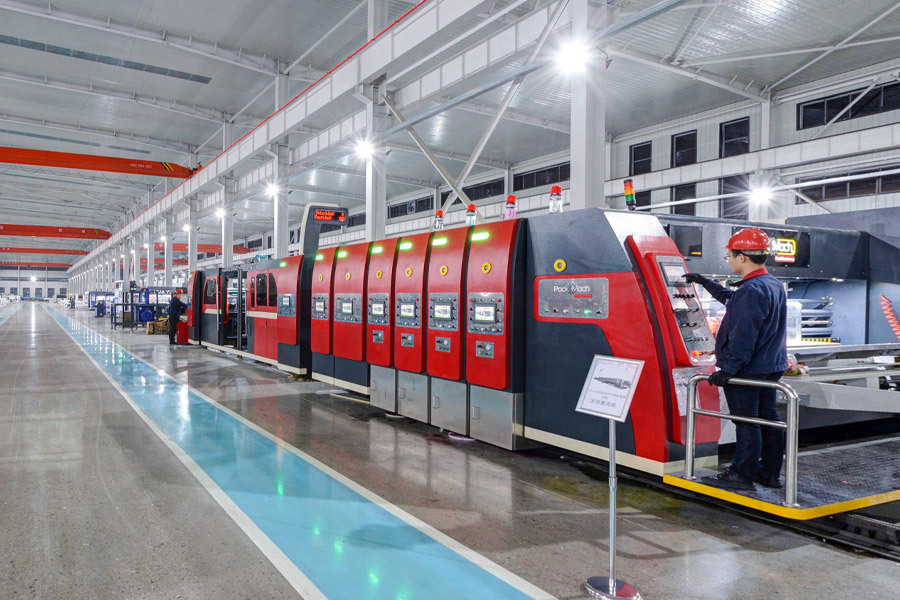
An automatic carton packing line is an integrated end-of-line system that automatically erects, fills, seals, and conveys corrugated or folded cartons without continuous manual intervention. It combines a box erecting and sealing line, an industrial packaging conveyor system, and — in modern configurations — a robotic carton loading system into a single, PLC-controlled workflow. The result: consistent throughput, reduced labor dependency, and measurable gains in packaging quality.
Why does this matter in 2026? Labor costs in U.S. manufacturing facilities have risen sharply, and secondary packaging automation is no longer a luxury reserved for Fortune 500 plants. Mid-market processors across food, pharmaceutical, and e-commerce fulfillment are actively deploying these systems to stay competitive. According to recent 2026 industry data, the global market for automated cardboard box packaging systems is on track to reach $10.7 billion by 2027, growing at a compound annual rate of approximately 5.9%.
At its core, a complete automatic carton packing line typically includes four functional stages: carton erection, product loading (either pick-and-place or sweep-fill), carton sealing via hot-melt glue or pressure-sensitive tape, and outfeed to a downstream palletizer or conveyor. Understanding that architecture upfront makes every downstream decision — supplier selection, budget allocation, integration planning — significantly cleaner. For a broader context on the equipment category, see the overview of packaging machine automation on Wikipedia.
How does a carton packing line differ from a cartoning machine?
This is a question that surfaces constantly in procurement conversations. A cartoning machine typically handles folded paperboard cartons at the primary packaging stage — think cereal boxes or medicine cartons. An automatic carton packing line, by contrast, operates at the secondary packaging level, grouping primary packages into corrugated shipping cases. The two can be adjacent on the same floor, but they serve distinct functions in the packaging hierarchy. Conflating them leads to mismatched RFQs and wasted evaluation time.
What does "end-of-line packaging automation" actually cover?
End-of-line packaging automation encompasses every process that occurs after primary packaging is complete: case packing, carton sealing, labeling, weighing, palletizing, and stretch wrapping. An automatic carton packing line sits at the heart of this zone. Some suppliers offer a packaging line turnkey solution that bundles all these stages; others specialize in individual modules. Knowing where your line starts and ends is essential before issuing an RFQ.
System types: which configuration fits your production?
The right system architecture depends entirely on your product geometry, SKU count, and throughput targets. There is no universal best choice — and any cartoning machine manufacturer that claims otherwise should raise a flag. Based on real-world plant assessments, five primary configurations dominate the U.S. market in 2026.
Top-load vs. side-load vs. robotic configurations
Top-load (vertical) lines drop products into an open-top corrugated case from above. They excel with fragile items — glass bottles, jars, individually wrapped snacks — where horizontal pushing would cause breakage or deformation. Changeover is straightforward, but the vertical drop height must be controlled to prevent impact damage.
Side-load (end-load) lines push products horizontally into an open-ended case using a sweep or pusher mechanism. This configuration handles regular, rigid products like canned goods, folded pouches, or retail boxes with excellent efficiency at speeds exceeding 30 cases per minute on well-tuned lines. It is the workhorse of the food and beverage sector.
A robotic carton loading system replaces the fixed pusher with one or more industrial robots — typically delta or SCARA arms — fitted with custom end-of-arm tooling. Actual testing in multi-SKU e-commerce environments reveals that robotic lines can reduce changeover time from 45 minutes to under 8 minutes when paired with vision-guided pick placement. The trade-off is a higher capital cost and a steeper integration learning curve.
Integrated open-erect-fill-seal lines and modular builds
A fully integrated box erecting and sealing line combines four formerly separate machines into one continuous footprint: the case erector, the load station, the flap folder, and the carton sealing machine. This approach minimizes inter-machine transfer points — which are statistically the most common jam locations — and reduces overall floor space by 15–25% compared to stringing separate modules together.
Modular builds, on the other hand, allow phased investment. A plant can start with a standalone case packing machine today and add automated erection and downstream conveyors in the next budget cycle. This flexibility is attractive for facilities that are still ramping production volume. Of course, there is a real risk: modules from different manufacturers rarely communicate cleanly out of the box, and integration costs can quietly erode the projected ROI.
| Configuration | Typical speed (cases/min) | Best-fit product type | Avg. changeover time | Relative CapEx |
|---|---|---|---|---|
| Top-load | 10–25 | Fragile, irregular | 20–40 min | $$ |
| Side-load | 20–50 | Rigid, uniform | 15–30 min | $ |
| Robotic | 8–35 | High-mix, varied SKU | <10 min | $$$ |
| Integrated (all-in-one) | 25–60 | High-volume, stable SKU | 30–60 min | $$$ |
| Modular | Variable | Growing operations | Variable | $ to $$$ |
Buyer's selection criteria: speed, footprint, product type, and budget
No competitor article provides a structured decision framework for procurement engineers — so let's build one here. Selecting an automatic carton packing line requires weighing four interdependent variables simultaneously. Optimize for only one and you will likely overspend or underperform on the others.
Speed and throughput matching
Here is a point many buyers miss: the correct target speed for your case packing machine is not your peak theoretical demand — it is your upstream bottleneck speed plus a 15–20% buffer. Oversizing is a genuine problem. A high-speed carton filling machine rated at 60 cases per minute feeding a production line capped at 30 cases per minute creates backpressure, jam accumulation, and unnecessary wear. Always map your entire line's OEE before specifying equipment speed.
Footprint, layout, and budget tiers
U.S. plant floors are expensive. A compact integrated line might require 400–600 square feet; a full robotic carton loading system with infeed conveyors and vision inspection can exceed 1,200 square feet. Before requesting quotes, sketch your available envelope including service access clearances — typically 36 inches minimum on all sides per OSHA 1910.36 egress requirements.
Budget tiers in 2026 break down roughly as follows. Entry-level semi-automatic systems start around $80,000–$150,000. Mid-range fully automatic lines with integrated carton sealing machines run $200,000–$500,000. High-speed or robotic configurations with full warehouse packaging automation capabilities typically land between $600,000 and $1.5 million installed. These figures exclude civil works, electrical upgrades, and compressed air infrastructure, which routinely add 10–20% to project cost.
Just as a production line is only as fast as its slowest machine, your budget is only as productive as the integration work surrounding the equipment itself. Skimping on commissioning and operator training is how plants end up with expensive idle hardware.
Total cost of ownership (TCO) and ROI analysis
A persistent industry misconception is that automation is a one-time capital expenditure. In reality, the total cost of ownership of an automatic carton packing line extends across the full operational life of the equipment — typically 10–15 years. Procurement teams that evaluate only CapEx routinely misstate their projected ROI by 30–50%.
Breaking down the full TCO
The five major TCO components are: initial equipment and installation cost, annual maintenance and spare parts (typically 2–4% of CapEx per year), consumables such as hot-melt glue and corrugated cases, software licensing or SCADA subscription fees in Industry 4.0 configurations, and operator training and requalification costs after personnel turnover.
According to PMMI's Packaging Machinery Industry Report, facilities that deploy end-of-line packaging automation with a full secondary packaging automation stack report average labor cost reductions of 40–60% within 18 months of commissioning. Packaging throughput efficiency improves by a factor of 3–5x compared to manual or semi-manual lines. These are population-level benchmarks — individual results depend heavily on pre-automation baseline performance.
"The facilities that extract the greatest ROI from packaging automation are not necessarily those with the fastest equipment — they are the ones that conducted the most rigorous pre-installation process mapping and post-installation OEE tracking." — PMMI Packaging Machinery Industry Report, recent findings
Payback period benchmarks by industry segment
Food and beverage plants running two or three shifts typically achieve payback in 18–30 months. Pharmaceutical packaging lines, which require more stringent validation and compliance documentation, often see payback periods of 30–48 months — but the labor-quality consistency gains are disproportionately valuable in that sector. E-commerce fulfillment centers with high-mix, variable-volume operations can expect 24–36 months payback when robotic configurations are properly sized. These ranges assume consistent utilization above 70% OEE.
Integration with upstream and downstream equipment
This is arguably the most underestimated challenge in any packaging line integration project. The automatic carton packing line does not operate in isolation — it sits between upstream filling, labeling, or inspection equipment and downstream palletizers, stretch wrappers, and warehouse management systems. Getting the handshakes right determines whether the system runs at design capacity or spends 30% of each shift in fault recovery.
PLC, SCADA, and Industry 4.0 protocol architecture
Modern automatic carton packing lines communicate via standardized industrial protocols: EtherNet/IP, PROFINET, and OPC-UA are the dominant options in U.S. plants as of 2026. OPC-UA in particular has become the preferred backbone for Industry 4.0 integration because it is hardware-agnostic and supports both vertical (machine-to-MES) and horizontal (machine-to-machine) data exchange simultaneously.
From a practical standpoint, the integration checklist for a new corrugated box packing equipment installation should include: confirming upstream filler output rate and product orientation specs, mapping reject-handling and accumulation buffer requirements, verifying PLC communication compatibility between the case packing machine and existing line PLCs, defining SCADA data points for OEE monitoring, and establishing E-stop integration across all equipment zones for safety compliance.
Conveyor pacing and buffer management
An industrial packaging conveyor system connecting the packing line to the palletizer must be sized with sufficient surge capacity — typically 60–90 seconds of product accumulation — to absorb the brief stops inherent in automatic carton cycling (case changeover, glue replenishment, label roll changes). Without adequate buffering, a minor downstream pause cascades into an upstream line shutdown within seconds. Real-world case studies from food processing plants show that correctly sized accumulation conveyors reduce line stoppage frequency by 40–55% compared to zero-buffer configurations. For more on carton construction standards that affect integration requirements, see the reference on carton packaging.
Troubleshooting and uptime optimization
Plant operations teams care about one thing above all else: keeping the line running. Yet most supplier documentation covers setup and operation while leaving troubleshooting to a brief appendix. This section addresses the gap directly.
The most common failure modes and how to prevent them
Based on real cases from multi-shift production environments, the top five failure modes in automatic carton packing lines are:
- Carton jam at the erector station — caused by humid corrugated board, inconsistent blank stack feeding, or worn vacuum cups. Prevention: humidity-controlled blank storage, weekly vacuum cup inspection.
- Hot-melt glue stringing or insufficient adhesion — caused by temperature drift in the glue gun, incorrect glue viscosity for ambient conditions, or worn nozzles. Prevention: temperature monitoring with alarm thresholds, nozzle replacement on a scheduled cycle.
- Product mis-load or short-pack errors — caused by upstream product spacing irregularity or worn infeed timing belts. Prevention: install a count verification sensor at the load station outfeed.
- Carton sealing flap fold failures — caused by worn tucker blades or incorrect flap score depth in the corrugated blank. Prevention: blade replacement schedule and incoming corrugated quality inspection.
- PLC fault escalation from sensor drift — caused by vibration-induced sensor misalignment or product dust accumulation on photoelectric eyes. Prevention: quarterly sensor alignment verification and compressed air blowdown schedule.
OEE improvement benchmarks and changeover best practices
World-class OEE for an automatic carton packing line in a high-volume environment is generally accepted as 85% or above. Most newly commissioned lines operate in the 65–75% range and require 6–12 months of process refinement to reach benchmark performance. The fastest gains typically come from reducing changeover time — a task that is more organizational than mechanical.
SMED (Single-Minute Exchange of Die) methodology applied to case format changeovers consistently reduces downtime by 30–50% in documented plant implementations. The practical steps: pre-stage all tooling and format parts before the prior run ends, convert internal adjustments to external pre-settings wherever possible, and document each changeover sequence with video for operator training standardization. Leading manufacturers of warehouse packaging automation equipment now offer tool-free quick-release format parts as a standard option — worth specifying in your RFQ.
Industry-specific applications and compliance
An automatic carton packing line deployed in a pharmaceutical clean room looks almost nothing like one running on a snack food line — and the regulatory distance between them is even greater than the mechanical difference. Procurement engineers must understand the application-specific requirements before selecting a supplier or drafting acceptance criteria.
Food and beverage: speed, sanitation, and PMMI standards
In food and beverage applications, the high-speed carton filling machine is expected to maintain throughputs of 30–60 cases per minute across 16–20 hour operating windows. Sanitary design — USDA-accepted materials, sloped surfaces, IP65-rated enclosures, and tool-less disassembly for washdown — is non-negotiable in direct-contact or open-product zones. PMMI B155.1 is the governing machinery safety standard for packaging equipment in North American food facilities. Specifying compliance in the purchase agreement protects the buyer during installation inspection and insurance underwriting.
AI-integrated machine vision is rapidly becoming standard on food-sector lines in 2026, enabling real-time detection of under-filled cases, misaligned labels, or damaged cartons before they exit the packing zone. This merges quality inspection and packaging into a single workflow step — reducing downstream returns and rework costs substantially.
Pharmaceutical: FDA 21 CFR Part 11 and serialization integration
Pharmaceutical secondary packaging automation must comply with FDA 21 CFR Part 11, which governs electronic records and electronic signatures for regulated manufacturing processes. In practice, this means the packing line's SCADA or HMI system must maintain immutable audit trails, enforce role-based access controls, and support batch record generation in a format acceptable to FDA inspectors.
Serialization integration is a parallel requirement under DSCSA (Drug Supply Chain Security Act). The case packing machine must either incorporate or interface with a serialization engine that applies and verifies unique 2D barcodes at the case level before sealing. Failing to specify this at the RFQ stage results in expensive field modifications post-installation.
E-commerce and omnichannel fulfillment: flexibility above all
E-commerce fulfillment centers present the most demanding SKU diversity of any application — hundreds of product configurations, variable order quantities, and frequent promotional packaging changes. The shrink wrap and carton bundling line, robotic loading cells, and variable-case-size erectors are the technologies of choice here. A key 2026 trend driving procurement decisions in this segment is the shift toward right-sized packaging: systems that automatically select or form the optimal case size for each order, reducing void fill, dimensional weight shipping costs, and corrugate consumption simultaneously.
Choosing the right automatic carton packing line: final summary
The decision to invest in an automatic carton packing line is rarely simple — but it does not have to be opaque. The framework is consistent regardless of industry: start with a rigorous throughput and product analysis, then match system configuration to your SKU complexity and changeover frequency targets. Build a complete TCO model before comparing CapEx numbers, and insist on a documented integration protocol that specifies PLC communication standards, buffer sizing, and safety interlock requirements.
Compliance requirements are non-negotiable and must be embedded in the specification, not added as an afterthought. And once the line is installed, OEE tracking and structured changeover improvement programs are what separate facilities that hit their ROI targets from those that perpetually underperform their projections. The right automatic carton packing line, properly integrated and maintained, delivers not just cost savings but a meaningful competitive advantage in production reliability and scalability.
Frequently asked questions
Q: How fast can a typical automatic carton packing line run?
A: Speed depends on configuration. Side-load and integrated lines commonly achieve 20–60 cases per minute. Robotic systems run 8–35 cases per minute but with superior format flexibility. Always size speed to your upstream bottleneck plus a 15–20% buffer — not to your theoretical peak demand.
Q: What is the typical payback period for end-of-line packaging automation?
A: For food and beverage facilities running multiple shifts, payback typically ranges from 18–30 months. Pharmaceutical lines with higher compliance overhead see 30–48 months. E-commerce robotic systems generally fall in the 24–36 month range, assuming OEE above 70%.
Q: What communication protocols do modern case packing machines support?
A: Leading systems support EtherNet/IP, PROFINET, and OPC-UA. OPC-UA is the preferred choice for Industry 4.0 environments in 2026 because it enables both machine-to-machine and machine-to-MES communication without proprietary middleware.
Q: What are the most common causes of downtime on a carton packing line?
A: The top causes are carton erector jams from humid blanks, hot-melt glue system failures, product mis-load errors from upstream spacing issues, tucker blade wear causing flap fold faults, and photoelectric sensor drift due to vibration or dust accumulation. Scheduled preventive maintenance addresses all five.
Q: Does a pharmaceutical automatic carton packing line need FDA 21 CFR Part 11 compliance?
A: Yes, if electronic records are maintained on the equipment. The SCADA or HMI must support immutable audit trails, role-based access control, and batch record export in an FDA-acceptable format. Serialization integration for DSCSA case-level tracking should also be specified at the RFQ stage to avoid costly retrofits.
Hot Tags:
NEXT:

Contact Us
E-mail:
jimlee0218@huayucartonmachine.com
Phone/WhatsApp:
+86-15226701321
Address:
Dongguang Economic Packing Machine Zone, Cangzhou City, Hebei Province, China

Contact: Mr. Jim Lee


REQUEST QUOTE